

Sometimes, yes—but usually not in the way owners imagine. Most dogs are not “afraid of wheelchairs” as an idea. They are reacting to a new body sensation: straps around the chest or hips, wheels moving behind them, a shift in balance, or the odd feeling of being supported where they used to do the work themselves. That first awkward reaction is common, especially with senior dogs, dogs in pain, and dogs recovering from surgery or sudden weakness.

Why dogs hesitate when they first use a wheelchair
A dog’s first reaction to a mobility cart is usually about sensation, not stubbornness. The dog is trying to figure out what changed: something is touching the body, the rear or front end is being lifted differently, the center of gravity feels off, and the normal walking pattern suddenly works in a new way.

That is why some dogs freeze. Some take tiny steps. Some try to sit. Some walk a few feet and then stop. These reactions often mean, “I do not understand this yet,” not “I will never accept this.”
| What the dog feels | How it looks to the owner | What it usually means | Helpful source |
|---|---|---|---|
| New harness pressure around chest, hips, or belly | Freezing, turning to look back, short hesitant steps | The dog is processing a new body sensation | VCA |
| Different balance and weight distribution | Leaning, wobbling, walking awkwardly at first | The dog needs time—or the current support style may not match the weakness pattern | AKC, DogWheelchair Fit & Sizing Center |
| Wheel motion behind or beside the body | Trying to step oddly, moving in bursts, stopping to look back | Normal first-session confusion | DogWheelchair Training / Transition |
| Cart rubbing or poor alignment | Refusing to move, trying to sit, skin irritation, obvious discomfort | Not a training problem first—a fit problem first | Are Dog Wheelchairs Worth It? |
| Owner moving too fast | Dog shuts down after being strapped in and pushed straight into a walk | The session started above the dog’s comfort level | VCA |
Normal adjustment vs. a real problem
This is where owners get stuck. A dog does not need to look thrilled on day one. Mild uncertainty is normal. What matters is whether the dog improves with short, calm practice—or keeps getting more stressed and less willing to move.

| What you see | Usually normal? | What to do |
|---|---|---|
| Sniffing the cart, pausing, then taking treats | Yes | Keep the session short and positive |
| Taking a few slow steps, then stopping to think | Yes | Reward and end before frustration sets in |
| Trying to sit immediately every time | Sometimes | Check cart height, strap pressure, and whether the support type is right |
| Panting, trembling, trying to escape, refusing food | No | Stop and lower the difficulty at the next attempt |
| Skin rubbing, awkward tilt, limbs not tracking naturally | No | Fix fit before doing more training |
| Walking better for a few minutes, then tiring out | Often yes | Build stamina gradually instead of making the session longer right away |
AKC notes that wheelchairs are not one-size-fits-all and should match the dog’s condition, structure, and support needs. That matters because many “fear” complaints are actually a mismatch problem: the dog needs a different style of support, not more encouragement.
How to help a dog adapt in the first week
The first week should be about understanding, not mileage. Think in stages. Let the dog learn the equipment before you ask for performance.

| Stage | Goal | What to do | Stop when... |
|---|---|---|---|
| Day 1 | Make the wheelchair familiar | Let the dog sniff the cart, inspect it, and earn treats around it before being fitted | The dog becomes tense or avoids the setup completely |
| Day 1–2 | Accept the harness and support points | Practice brief fitting without asking for a walk yet | The dog looks distressed or the straps clearly bother the skin |
| Day 2–3 | Take a few controlled steps | Use flat ground, a quiet area, and food or praise for each calm step | The dog starts to scramble, twist, or shut down |
| Day 3–5 | Build confidence | Add a little more distance only after the dog is moving with less hesitation | You see fatigue before confidence |
| Day 5–7 | Build routine | Keep sessions short but regular, and end while the dog still feels successful | The dog is worsening instead of improving |
DogWheelchair’s training guidance specifically frames acclimation as a staged process that starts short and gradually builds. That is exactly the right way to think about it. A short successful session beats one long discouraging session every time.
A fit and comfort checklist before every session
Owners often focus on emotion first, but comfort comes first. A dog cannot learn to like a setup that pinches, rubs, tilts, or supports the wrong part of the body.
| Checkpoint | What you want to see | Red flag |
|---|---|---|
| Cart height | Dog stands in a natural posture, not forced too high or low | Back arches oddly or shoulders dip unnaturally |
| Body alignment | Dog tracks mostly straight and does not lean excessively to one side | Constant tilt or dragging on one side |
| Harness contact | Secure but not digging into skin | Immediate rubbing, twisting, or pressure marks |
| Support style | Rear support for hind-end weakness, front support for front-end weakness, 4-wheel for multi-limb/balance issues | Dog seems unstable because the wrong end is doing too much work |
| Session length | Short enough that the dog finishes with energy left | Dog ends every session exhausted and frustrated |
Why the cart type matters more than owners think
Dogs adapt faster when the wheelchair matches the actual weakness pattern. A dog with weak back legs often does well in a rear-support cart because the front legs can still drive movement. A dog with front-end weakness or weakness at both ends may struggle badly in the wrong setup and appear “afraid” when the real problem is that the cart is asking the body to move the wrong way.
| Dog’s mobility pattern | Usually the best starting support | Why | Source |
|---|---|---|---|
| Rear-leg weakness, front legs still strong | Rear-support 2-wheel cart | Lets the dog pull naturally with the front legs | DogWheelchair Back Legs |
| Front-leg weakness, rear legs still strong | Front-support cart | Takes pressure off the front body while preserving rear drive | DogWheelchair Front Legs |
| Support needs may change during recovery | Universal front/rear design | Gives more flexibility during rehab or evolving weakness | Universal Dog Wheelchair |
| Weakness in both front and back legs, poor balance, wobbling, tipping | 4-wheel full-support cart | Provides the highest stability and supports both ends of the body | 4-Wheel Dog Wheelchair, Dog Stroller vs. Dog Wheelchair |
DogWheelchair products that match different support needs
For this topic, the product section works best when it reinforces the article’s main point: dogs adapt better when the support type fits the problem. That makes the product recommendation feel helpful instead of forced.
| Product | Best for | Site details | Product page |
|---|---|---|---|
| Adjustable Dog Wheelchair for Back Legs (For Small Dogs) | Small dogs with hind-end weakness | Aluminum frame, recommended pet weight up to 22 lb, item weight 2.2 lb, rubber shock-absorbing wheels | View |
| Dog Wheelchair for Front Legs (For Small & Medium Dogs) | Dogs that need front-end support while rear legs still move well | Aviation-grade aluminum alloy, adjustable height/length/width, open rear area for bathroom use | View |
| Universal Dog Wheelchair for Front or Rear Legs (2-in-1) | Owners who want flexibility for rehab or changing needs | 2-in-1 front/rear support, push-button adjustment, anti-chafe guards, hollow aviation aluminum | View |
| 4-Wheel Dog Wheelchair, Full Support Cart for Front & Back Legs | Dogs with multi-limb weakness, tipping, or poor balance | Full-body support, front and rear harness system, lightweight aluminum alloy frame, XS/S/M/L sizing | View |

Adjustable Dog Wheelchair for Back Legs
This is the best match when the dog’s main issue is in the hind end. That often makes the adaptation process easier because the front legs still know how to lead the movement.

Dog Wheelchair for Front Legs
For dogs that cannot comfortably carry the front end, front support makes a big difference. It also keeps the article focused on the real decision owners face: not whether the dog is “being difficult,” but whether the support style fits the body.
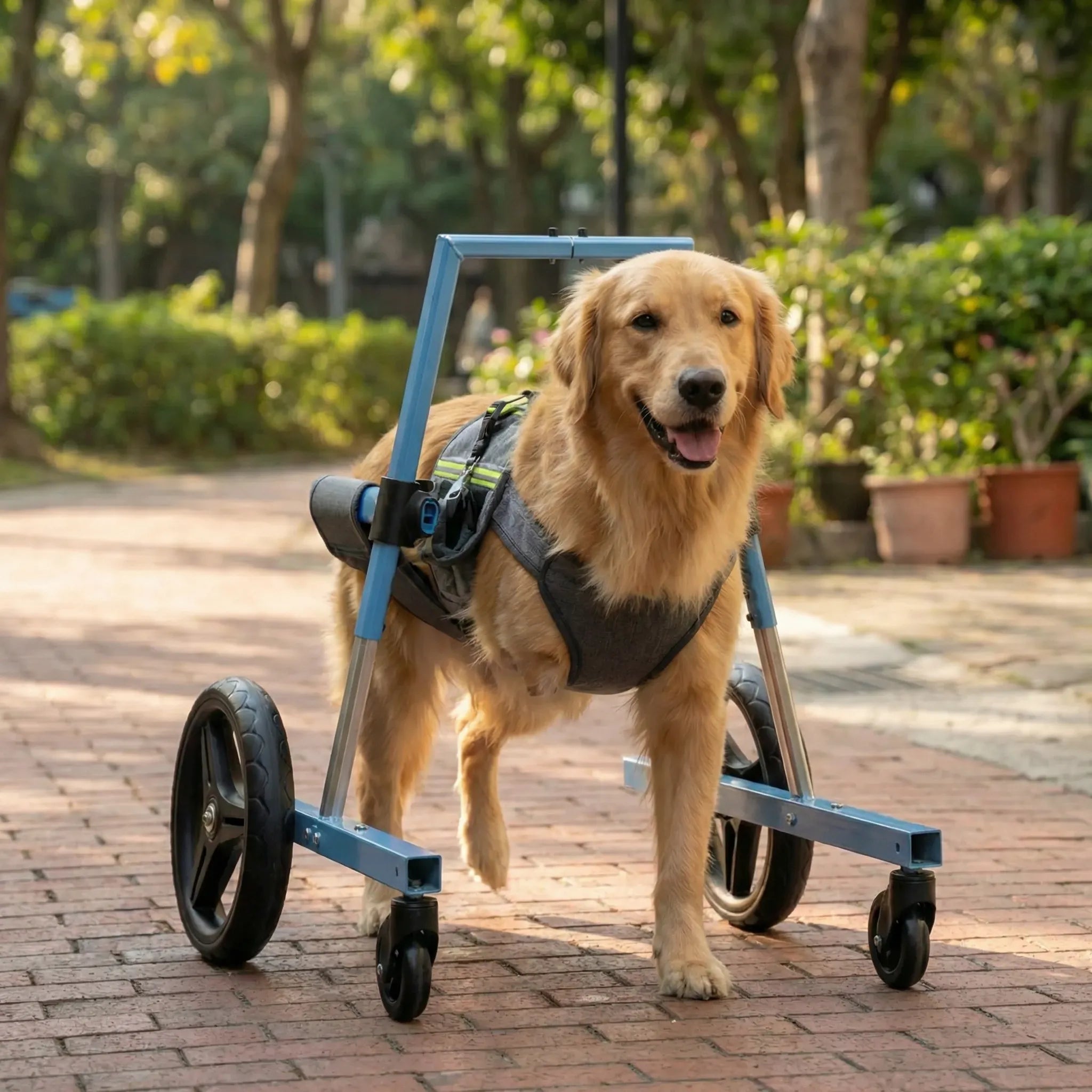
Universal Dog Wheelchair for Front or Rear Legs
This is a strong fit for owners who are still sorting out whether front support or rear support will work best, or who expect mobility needs to change during recovery.

4-Wheel Dog Wheelchair, Full Support Cart
When both ends are weak, or the dog keeps wobbling and tipping, a 4-wheel setup often feels more stable and more understandable to the dog than trying to force a lighter cart that does not meet the actual need.
Common mistakes that make dogs hate the process
| Mistake | Why it backfires | Better move |
|---|---|---|
| Strapping the dog in and immediately going for a long walk | The dog has not had time to understand the sensation or mechanics | Start with familiarization, then fitting, then a few steps |
| Assuming every refusal is fear | You may miss a fit issue, pain issue, or wrong support style | Check comfort and match before pushing training |
| Making sessions too long too early | Fatigue makes the dog associate the cart with stress | Stop early and let success build motivation |
| Changing surface, distance, and pace at the same time | Too many new variables hit at once | Change one thing at a time |
| Ignoring subtle signs of rubbing or awkward posture | Small discomfort becomes a major aversion | Check the body after every early session |
| Using the wrong mobility aid entirely | Some dogs need a stroller for transport or a harness for short support, not a long cart session right away | Match the tool to the daily job |
The bottom line
Yes, some dogs are nervous about their wheelchair at first. But in many cases, what owners are seeing is not pure fear. It is a mix of confusion, new physical sensation, changed balance, and sometimes plain discomfort from a cart that has not been adjusted correctly yet.
That is good news, because those problems are workable. When the fit is right, the support style matches the dog’s real weakness pattern, and the first week is handled in short calm stages, many dogs improve fast. The goal is not to force a brave reaction. The goal is to make the wheelchair feel understandable, comfortable, and useful.
FAQ
Do dogs get scared of their own wheelchair?
Some do at first, but the reaction is usually about unfamiliar sensation and balance, not a permanent fear of the cart itself.
How long does it take a dog to get used to a wheelchair?
It varies. Some dogs settle in within a few short sessions, while others need a slower transition over several days or longer. Short successful sessions usually work better than long ones.
What if my dog freezes in the wheelchair?
Pause and go backward a step. Check the fit, shorten the session, and return to calm familiarization before asking for more movement.
How do I know if the wheelchair fit is wrong?
Look for rubbing, leaning, obvious discomfort, refusal to move every time, or posture that looks forced rather than natural.
Is a 4-wheel cart better than a 2-wheel cart?
Not automatically. A 2-wheel rear cart is often better for simple hind-end weakness. A 4-wheel cart is usually better when both ends are weak or the dog is unstable and tips easily.
Should I consider something other than a wheelchair?
Sometimes, yes. For short support tasks, a rear lift harness may be enough. For transport, a stroller may make more sense. The right choice depends on the dog’s daily routine and level of weakness.
Choose the support type that fits the dog—not just the product photo
External references in this article link to AKC and VCA for general guidance on mobility devices and desensitization. External links are marked nofollow.
0 comments