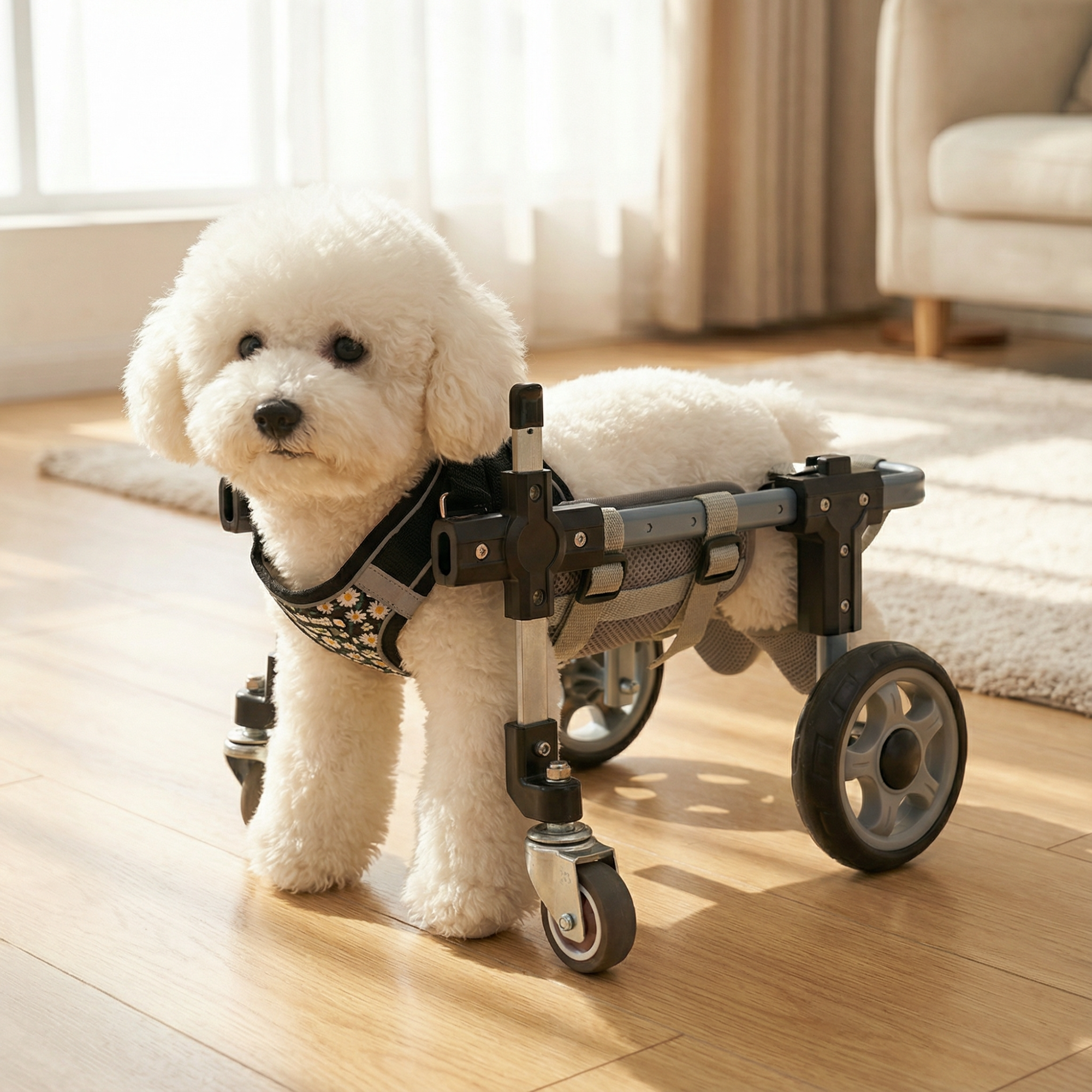
Full Support Dog Wheelchair for Front & Back Legs
When weakness affects both ends of the body, rear support alone may not provide enough stability. This full support dog wheelchair uses a four-wheel frame with front and rear body support to help small dogs stay upright, balanced and mobile. Designed specifically as a dog wheelchair for front and back legs, it gives dogs with multi-limb weakness or poor balance a more stable way to stand, practice walking and stay engaged in everyday life.
Why Choose a 4-Wheel Full Support Dog Wheelchair?
A standard rear-support cart mainly lifts the hindquarters. A 4 wheel full support dog wheelchair adds stabilization at the front of the body as well, making it a better match for dogs whose mobility challenges involve more than the rear legs.
Support for All Four Limbs
The four-wheel frame works as a dog wheelchair for all four legs, providing additional stability when both the front and hind limbs have difficulty supporting the body consistently.
Better Balance for Unsteady Dogs
Full-body support can help keep the torso more level and reduce the amount of balancing work the dog must perform while standing or moving on flat surfaces.
Adjustable Around Your Dog
The frame can be adjusted in height, body length and width, allowing this adjustable full support dog wheelchair to be fitted more closely to your dog's proportions.
Designed for Daily Mobility
Lightweight construction, supportive straps and smooth-rolling wheels help make assisted standing, short walks and supervised mobility sessions easier to manage.
Is a Full Body Support Dog Wheelchair Right for Your Dog?
This cart is intended for dogs that need meaningful support at both ends of the body, rather than support for only one pair of legs.
This Full Support Mobility Cart May Be a Good Fit If Your Dog:
- Has weakness or instability in both the front and back legs
- Has difficulty staying upright without assistance
- Frequently loses balance or tips while attempting to walk
- Needs more overall stability than a two-wheel cart provides
- Benefits from supported standing during supervised mobility sessions
- Needs a small-dog full support wheelchair with an adjustable frame
Check With Your Veterinarian First If:
- Your dog recently had surgery
- Your dog has a spinal or neurological condition
- Your dog has severe pain when standing or being handled
- Your dog has significant breathing or heart-related limitations
- You are unsure whether assisted walking is appropriate
Designed for Stable, Full-Body Mobility Support
Every part of this full body support dog wheelchair is intended to work together as a balanced mobility system rather than simply lifting the rear legs.
| Product Type | 4-wheel full-support mobility cart for dogs |
|---|---|
| Primary Support | Front and rear body support for dogs with multi-limb weakness or instability |
| Frame | Lightweight aluminum alloy construction |
| Adjustability | Adjustable height, body length and width |
| Harness System | Front and rear support harnesses with adjustable straps |
| Wheel Configuration | Four-wheel layout for added full-body stability |
| Available Sizes | XS, S, M and L |
| Bathroom Access | Open underside designed to allow normal urination and defecation |
| Recommended Surfaces | Flat indoor flooring, sidewalks and short, even grass under supervision |
How to Choose the Right Full Support Dog Wheelchair Size
Fit matters as much as wheelchair design. Before ordering, measure your dog while standing naturally whenever possible. Do not choose a size based only on breed or body weight.
Measure Body Length
Measure from the base of the neck to the base of the tail along the body.
Measure Chest Girth
Wrap the measuring tape around the widest part of the chest without pulling it tight.
Match Both Measurements
Choose the size where both body length and chest girth fall within the listed range.
| Size | Body Length | Chest Girth |
|---|---|---|
| XS | 22–27 cm 8.7–10.6 in |
32–37 cm 12.6–14.6 in |
| S | 26–31 cm 10.2–12.2 in |
32–37 cm 12.6–14.6 in |
| M | 30–37 cm 11.8–14.6 in |
36–46 cm 14.2–18.1 in |
| L | 38–46 cm 15.0–18.1 in |
42–55 cm 16.5–21.7 in |
Helping Your Dog Adjust to a Quad Dog Wheelchair
A quad dog wheelchair changes the way your dog balances and moves. Some dogs begin moving quickly, while others need several short sessions to understand the new support.
4-Wheel Full Support vs. 2-Wheel Rear Support
Choosing the right mobility cart depends on where your dog needs support. A four-wheel cart is intended for a different mobility situation than a conventional rear-support wheelchair.
| Feature | 4-Wheel Full Support Cart | 2-Wheel Rear Support Cart |
|---|---|---|
| Primary purpose | Support both the front and rear of the dog | Primarily support the hindquarters |
| Best suited for | Front + rear weakness, poor balance or multi-limb instability | Rear-leg weakness with reasonably strong front legs |
| Number of wheels | Four | Two |
| Body stabilization | Front and rear support | Primarily rear support |
| Balance assistance | Higher full-body stability | Relies more heavily on front-leg balance |
What's Included
The system includes the main components required to configure the wheelchair for your dog.
Important Use & Safety Notes
A full support wheelchair for small dogs is a mobility aid, not a substitute for veterinary diagnosis, treatment or rehabilitation. Use the cart only while your dog is awake and supervised.
Avoid stairs, steep slopes, deep sand, rough terrain and any surface where the wheels could become trapped. Check your dog's chest, abdomen, hips and contact points regularly for rubbing or pressure, especially during the first several sessions.
If your dog shows pain, unusual breathing, distress, skin irritation or a significant change in mobility, stop the session and consult your veterinarian.
Full Support Dog Wheelchair FAQs
What is a full support dog wheelchair?
A full support dog wheelchair is a four-wheel mobility cart designed to stabilize both the front and rear of a dog's body. It is intended for dogs that need more overall support than a conventional two-wheel rear-support cart provides.
Is this a dog wheelchair for front and back legs at the same time?
Yes. This model is designed to support the front and back of the dog simultaneously. It is different from convertible designs that are configured for either front-leg or rear-leg use.
Which dogs may benefit from a 4-wheel full support dog wheelchair?
It may be suitable for dogs with weakness affecting multiple limbs, difficulty maintaining balance, or insufficient stability in a two-wheel cart. A veterinarian can help determine whether supported walking is appropriate for your dog's individual condition.
Can my dog pee and poop while using the wheelchair?
The open underside and rear area are designed to preserve bathroom access. Proper frame height and harness positioning are important, so check your dog's clearance after the initial fitting.
How do I choose the correct size?
Measure body length from the base of the neck to the base of the tail and measure chest girth around the widest part of the chest. Select a size where both measurements fit within the listed range.
Can a senior dog use a full body support dog wheelchair?
Some senior dogs can benefit from additional full-body stability, but age alone does not determine whether a wheelchair is appropriate. Very frail dogs or dogs with complex medical conditions should be evaluated by a veterinarian before assisted walking begins.
Can this quad support dog wheelchair be used outdoors?
It can be used on flat, stable outdoor surfaces such as sidewalks and short grass with supervision. Avoid stairs, steep slopes, deep or loose ground, and very rough terrain.
How long does it take a dog to get used to a four-wheel wheelchair?
Adaptation time varies. Some dogs understand the cart within a few sessions, while others need several days of short, positive practice. Start slowly and increase session length only when your dog appears comfortable.
Is the frame adjustable?
Yes. The height, length and width can be adjusted to better match your dog's proportions, while the support straps can be fine-tuned after the basic frame fit is established.
When should I consider four-wheel support instead of a two-wheel cart?
Four-wheel support may be worth considering when a dog cannot consistently balance with the front legs alone, has weakness affecting both ends of the body, or needs significantly more stabilization than a rear-support cart can provide.
Give Your Dog More Support From Front to Back
When mobility challenges involve the whole body, the right support system can make assisted standing and movement easier to manage. Choose the size that matches both your dog's body length and chest girth, then fine-tune the adjustable frame for a comfortable, balanced fit.