

It is one of the hardest questions dog parents ask, because what you are really asking is not just whether a cart works. You are asking whether your dog can still enjoy walks, feel like themselves, and have a good life.
That is also why a blanket “yes” or “no” is not very useful. The better question is this: does your own dog look more comfortable, more willing to move, and more engaged with life when supported?

What the real answer looks like
Dogs do not think about wheelchairs the way people do. They are not worried about appearances. They care about whether they can move comfortably, sniff interesting things, stay close to you, and get through the day without frustration.

In practical terms, dogs tend to do well in wheelchairs when four things are true at the same time:
Rear weakness usually needs a rear-support cart. Front-leg weakness needs a front-support cart. Dogs with tipping, wobbling, or weakness in more than one area often do better in a full-support 4-wheel design.
A good cart should support your dog without rubbing the armpits, groin, belly, or chest. The frame should track straight instead of pulling sideways.
A wheelchair should support movement. It should not be used to push a painful dog through activity they clearly do not want.
Most dogs do better with short, easy, confidence-building sessions first, not one long “test walk.”
If those four pieces are in place, many dogs look visibly brighter: they want to go outside again, they sniff more, they hold their head higher, and they stop getting stuck after only a few steps.
What the research and veterinary sources suggest
The strongest answer is not “dogs in wheelchairs are always happy.” The strongest answer is that assisted mobility can improve day-to-day quality of life when it is fitted and managed well.
| Source | What it adds | Why it matters to this question |
|---|---|---|
| 2024 assistive mobility cart study (PMC) | Caretakers reported improved quality of life in 62% of dogs and improved caretaker quality of life in 61% of cases. The same study also found complications were common, with wounds making up a large share of those complications. | Wheelchairs can help, but only if you take fit, friction, skin checks, and session length seriously. |
| AKC: Wheelchairs for Dogs | AKC notes that a well-fitted wheelchair may improve mobility and quality of life, and warns that poor fit can lead to pain or sores. | Happiness is closely tied to comfort, not just movement. |
| AKC: Mobility Devices for Dogs | AKC explains that wheelchairs can prevent dogs from dragging their bodies and injuring themselves, while also supporting more natural movement. | A dog who can move more safely is often a dog who is less frustrated. |
| VCA: Pets with Disabilities | VCA explains that pets with disabilities can still have a good quality of life and, in many cases, a nearly normal life expectancy. | The diagnosis is not the whole story. Daily function matters. |
| VCA: Homecare for Paralyzed Pets | Rehabilitation plans can provide pain relief, mental stimulation, reduced muscle loss, improved blood flow, and better core strength. | A happy wheelchair dog usually has a bigger support plan than the cart alone. |
| Royal Canin Academy | Proper adjustment matters: frame centered at the chest, harness close to the body, and wheels angled away correctly. | Fit determines whether a dog feels supported or annoyed. |
Put simply: the evidence points toward cautious optimism. A wheelchair can absolutely support a happy life, but it is not a “strap it on and hope” tool.
Signs your dog is comfortable and enjoying it
You cannot ask your dog, “Are you happy in this cart?” But you can read their behavior. Comfort, confidence, and willingness are the clues that matter most.

| What you see | Usually means | What to do next |
|---|---|---|
| Relaxed body, soft face, normal breathing, interest in sniffing | Your dog is coping well and likely feels safe enough to explore | Keep sessions short and positive; end before they fatigue |
| Walking toward the door when the cart comes out | The wheelchair predicts something good | Use that momentum; keep your routine consistent |
| Tail in a normal position, brighter expression, looking around | Confidence is improving | Add easy turns, sniff breaks, and familiar routes |
| Smoother tracking, fewer stumbles, less dragging | The fit and support style are probably close to right | Do a skin check after every session and increase time gradually |
| Better appetite or better rest after supervised activity | Gentle movement may be helping mood and daily rhythm | Stay consistent rather than trying to do more all at once |
Dog Wheelchair’s own transition and time-in-cart guides repeatedly center the same practical markers: relaxed body language, smooth movement, clean skin after use, and growing interest in getting out and moving again. Their related guides on when to start a wheelchair and how long a dog can stay in a wheelchair are worth reading together if you are in the early stage.
Signs your dog is not happy in the cart yet
“Not happy yet” does not always mean “never.” Sometimes it means the cart type is wrong, the fit is off, the session was too long, or pain is not under control.
| Warning sign | Possible reason | Best next move |
|---|---|---|
| Freezing, refusing to move, shutting down | Stress, poor first introduction, bad fit, or pain | Stop the session, reward calm standing, shorten the next try, and review fit |
| Rapid panting with a tight mouth, obvious stress, wet paw prints indoors | Stress or discomfort | Use ASPCA body-language signs as a guide and reduce the challenge level |
| Armpit, groin, belly, or chest redness after use | Rubbing or pressure | Do not “push through.” Refit the harness, check centering, and shorten time |
| Head low, sloppy gait, wobbling more as the walk goes on | Fatigue | Cut back session length and add breaks |
| Whimpering, snapping when touched, hiding, or avoiding the harness | Pain or strong aversion | Talk with your veterinarian before trying to “train through” it |
| One side of the body looks more loaded than the other | Uneven adjustment or wrong support style | Recenter the frame and check whether a different cart style is needed |
Cornell’s canine pain guide lists behavior changes such as reluctance to move, altered posture, panting at rest, vocalization, and social withdrawal as important clues that a dog may be hurting. ASPCA guidance on canine body language also points to tight-mouth panting and stiff movement as stress signs. When you see those signals, back up and troubleshoot instead of forcing progress.
Helpful references: Cornell on recognizing pain in dogs and ASPCA Pro on canine body language.
Who is a good wheelchair candidate?
The best wheelchair candidates are usually dogs who still want to participate in life but need mechanical help to do it safely. That “want to” piece matters a lot.

| Situation | Usually a good fit? | Best support direction |
|---|---|---|
| Back legs weak, front legs still strong | Often yes | Rear-support wheelchair |
| Front legs weak, back legs still push well | Often yes | Front-support wheelchair |
| Balance poor, tipping, or both ends affected | Often yes, but needs more support | Full-support 4-wheel cart |
| Sudden pain crisis, severe neurologic change, or obvious distress | Not before a vet check | Pause and get evaluated first |
| Open sores or skin breakdown where straps touch | Not yet | Heal skin and fix fit before resuming |
| Very frail dog with too little strength to steer or propel | Sometimes no, or not this model | May need a different support tool or rehab-first plan |
Dog Wheelchair’s sizing center makes the same point in plain language: choose support based on where your dog is weak and where your dog is still strong. Rear carts are best when front legs can pull and steer, front carts are best when rear legs can drive the dog forward, and 4-wheel carts make sense when your dog needs more full-body stability. See their Fit & Sizing Center for the full measurement flow.
A simple 14-day wheelchair transition plan
Dog parents often make the same mistake: they finally get the cart, then try a long walk on day one. A better plan is to build skill, confidence, and comfort first.

| Timeframe | Goal | Suggested session | Stop if you see |
|---|---|---|---|
| Days 1–3 | Neutral or positive first impression | 5–10 minutes, flat ground, lots of praise, a few calm steps, then done | Freezing, panic, rubbing, frantic panting, repeated collapse |
| Days 4–7 | Build confidence | 10 minutes, twice a day, add sniff breaks and easy turns | Head dropping, sloppy movement, skin pinkness, refusal |
| Week 2 | Build routine | 15–20 minutes, 2–3 times a day if your dog stays bright and comfortable | Fatigue, limping after use, sore paws, aversion to harness |
| Established use | Quality movement, not maximum minutes | Many dogs do well around 20–60 minutes with breaks, depending on condition and fit | Any decline in enthusiasm, comfort, or skin condition |
This is consistent with Dog Wheelchair’s own time-in-cart guidance: start short, increase in small steps, and use body language and skin checks to decide whether to advance. Their schedule examples also include brief “movement snacks” during the day instead of relying on one long outing.
If your dog is post-op or in formal rehabilitation, let your veterinarian or rehab team set the pace. More time is not always better.
Common mistakes that make dogs hate wheelchairs

Size charts are measurement-based for a reason. Chest girth, height, body length, and leg spacing matter more than rough breed or weight guesses.
A rear cart on a dog whose front end is the real problem can feel frustrating fast. So can a front cart on a dog that actually needs whole-body stability.
Even a promising setup can create friction points. Check every contact area after each session, especially in the first two weeks.
If your dog mainly wants to go out but not actually walk much, a stroller may be the better tool for some outings. Dog Wheelchair’s stroller-vs-wheelchair guide explains this difference well.
A wheelchair is for supervised movement and supported activity. It is not where your dog should spend the whole day.
If your dog shows pain signs before or during setup, get that addressed first. A wheelchair can support a dog with weakness; it should not be used to ignore a painful medical problem.
Dog Wheelchair products worth considering
The right product depends on where your dog needs support. Below are four site-backed options that line up with the most common real-life scenarios.

1) Adjustable Dog Wheelchair for Back Legs (For Small Dogs)
This is the clearest “first stop” for dogs whose back end needs help but whose front legs still pull well. The product page highlights adjustable front-back and height settings, breathable 3D mesh support, shock-absorbing rubber wheels, reflective trim, and easy on/off buckles.
| Published detail | What it means in plain English |
|---|---|
| Price: $149.99 | A practical entry point if your dog needs targeted rear support instead of a more complex full-support cart. |
| Sizes: XS, S, M | Useful for many smaller dogs, but measure carefully instead of guessing by breed. |
| Recommended pet weight: up to 22 lb | Weight is only a rough guide. The size chart is the better tool. |
| Frame material: aluminum | Lightweight matters because the cart should not feel like dead weight behind your dog. |
| Item weight: 2.2 lb | Helpful for small dogs who need less bulk. |
| Size | Chest girth | Front ↔ rear leg distance | Left ↔ right front leg distance | Frame width | Frame length | Height |
|---|---|---|---|---|---|---|
| XS | 13.8–16.1 in / 35–41 cm | 4.3–9.3 in / 11–23.5 cm | 1–7.7 in / 2.5–19.5 cm | 6.4–8.7 in / 15.5–22 cm | 9.6–13.8 in / 24.5–35 cm | 6.7–11.8 in / 17–30 cm |
| S | 15–17.7 in / 38–45 cm | 5.5–11.8 in / 14–30 cm | 1.6–9.3 in / 4–23.5 cm | 6.4–8.7 in / 15.5–22 cm | 9.6–13.8 in / 24.5–35 cm | 6.7–11.8 in / 17–30 cm |
| M | 18.1–22.8 in / 46–58 cm | 7.1–14.6 in / 18–37 cm | 2.8–13 in / 7–33 cm | 6.4–8.7 in / 15.5–22 cm | 9.6–13.8 in / 24.5–35 cm | 6.7–11.8 in / 17–30 cm |

2) Dog Wheelchair for Front Legs (For Small & Medium Dogs)
This is not the cart most dog parents think of first, but it fills a very real need. The product page specifically notes that it is meant for dogs with front-leg issues and strong back legs. The frame is aluminum, the front wheels are EVA foam, the rear wheels are swivel casters, and the design stays open enough that bathroom use is not blocked.
| Published detail | Why it matters |
|---|---|
| Price: $199.99 sale price | A targeted front-support option when a rear-support cart would be the wrong tool. |
| Adjustable height, length, and width | Front carts need clean chest positioning so the dog does not feel pulled down or pinched. |
| Open design | Bathroom-friendly setup matters for daily use. |
| Usage note from page | Best for front-leg issues with strong rear legs; not ideal for very frail dogs with whole-body weakness. |
| Size | Back height (floor to top of chest/back) | Chest girth |
|---|---|---|
| S | 24–33 cm / 9.4–13.0 in | 38–50 cm / 15.0–19.7 in |
| L | 24–33 cm / 9.4–13.0 in | 48–62 cm / 18.9–24.4 in |
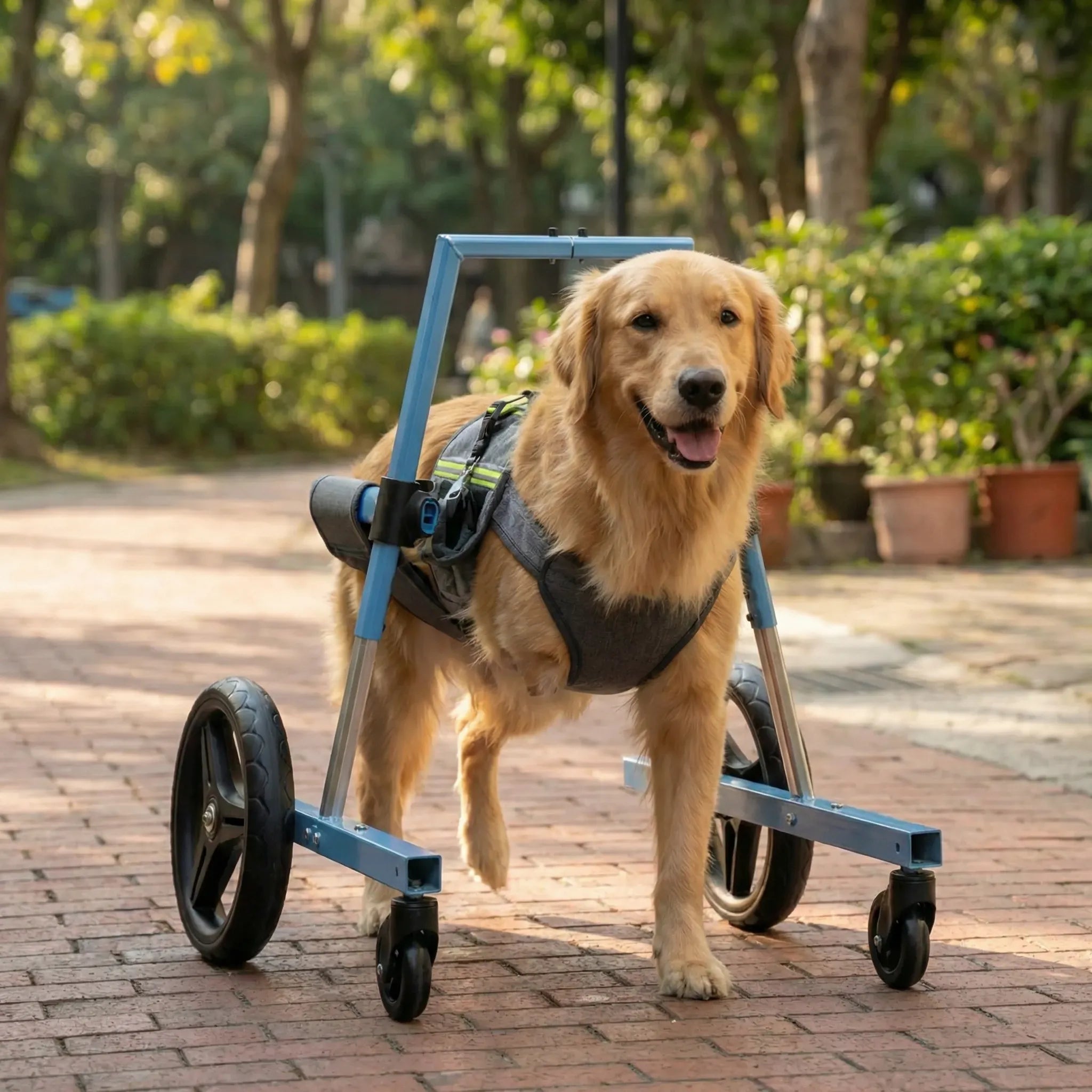
3) Universal Dog Wheelchair for Front or Rear Legs (2-in-1)
This is the most flexible option on the site. The product page says it can switch between front-leg and rear-leg mode by adjusting wheel positions, and it covers sizes from XS through XXL. It also uses a hollow aviation aluminum frame, push-button adjustments, anti-chafe protection, and shock-absorbing tires.
| Size | Breed examples listed on page | Approx. frame weight |
|---|---|---|
| XS | Toy Poodle, Shih Tzu, Bichon Frise | 1.2 kg / 2.6 lb |
| S | Schnauzer, Shetland Sheepdog | 1.3 kg / 2.9 lb |
| M | Border Collie, Chow Chow | 3.2 kg / 7.1 lb |
| L | Husky, Samoyed | 3.3 kg / 7.3 lb |
| XL | Golden Retriever, Saint Bernard, Labrador Retriever | 3.4 kg / 7.5 lb |
| XXL | German Shepherd, Alaskan Malamute | 3.5 kg / 7.7 lb |
This is the strongest “room to grow” option here, but it is still worth measuring carefully and asking support for help if your dog falls between sizes.
View universal 2-in-1 wheelchair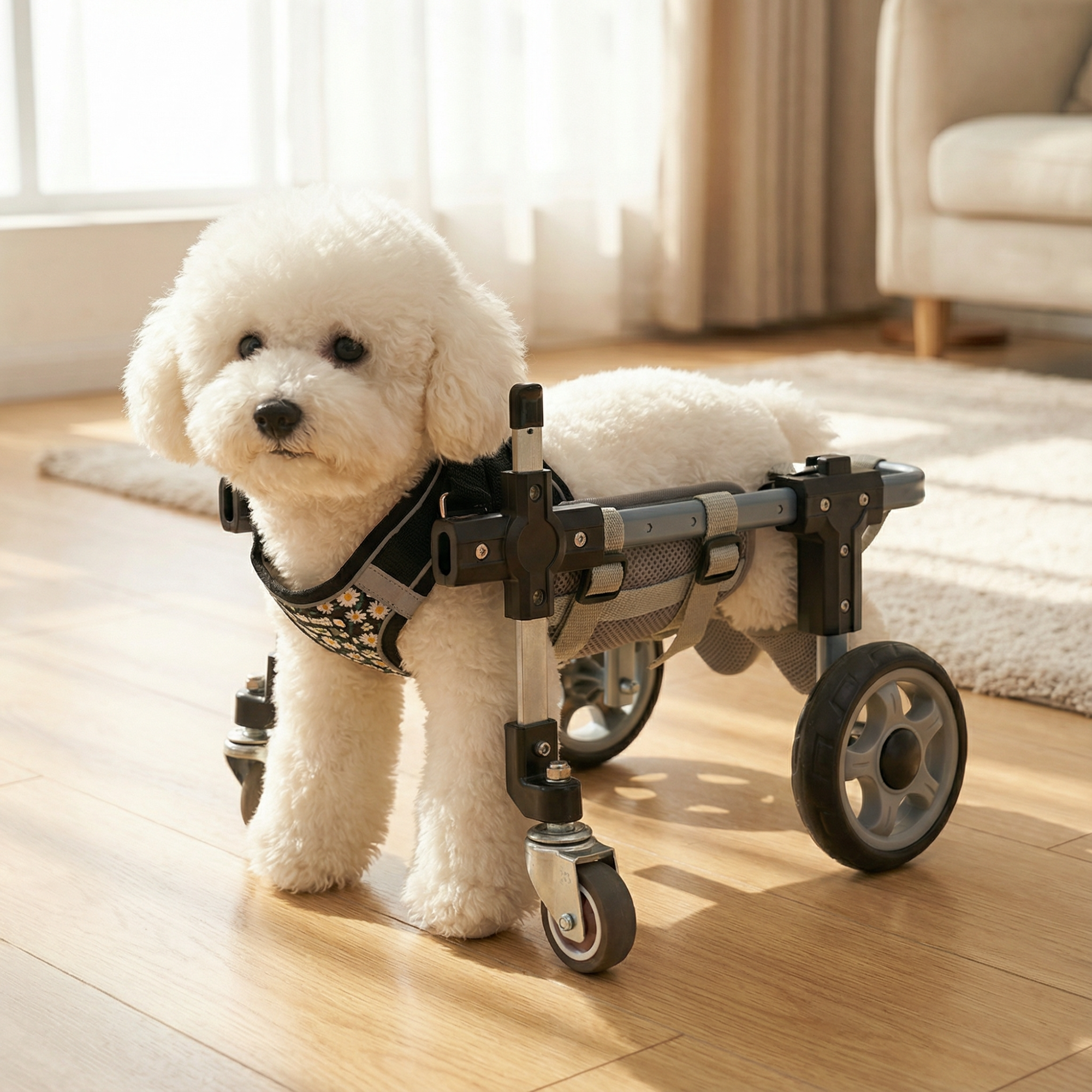
4) 4-Wheel Dog Wheelchair, Full Support Cart for Front & Back Legs (For Small Dogs)
If your dog struggles at both ends or looks unstable rather than simply weak in one area, a full-support cart is often the smarter choice. Dog Wheelchair’s own mobility guide says the 4-wheel cart is built for dogs who need full-body help.
| Published detail | What it means |
|---|---|
| Price: $187.99 | A step up in support without jumping to the universal large-size platform. |
| Sizes: XS, S, M, L | Enough range for many small dogs who need more stability than a 2-wheel setup can offer. |
| Full-support design | Better for dogs who tip, wobble, or need help at both ends. |
| Size | Body length | Chest girth |
|---|---|---|
| XS | 22–27 cm / 8.7–10.6 in | 32–37 cm / 12.6–14.6 in |
| S | 26–31 cm / 10.2–12.2 in | 32–37 cm / 12.6–14.6 in |
| M | 30–37 cm / 11.8–14.6 in | 36–46 cm / 14.2–18.1 in |
| L | 38–46 cm / 15.0–18.1 in | 42–55 cm / 16.5–21.7 in |
FAQ
Do dogs get depressed in wheelchairs?
Usually, the wheelchair itself is not what causes emotional decline. Loss of movement, pain, frustration, and isolation are the bigger problems. A well-fitted cart can often improve mood because it gives the dog a way to participate again.
How can I tell if my dog likes the wheelchair?
Look for willingness, not perfection. A dog who moves toward the door, sniffs, stays relaxed, and settles well after use is usually telling you the setup is helping. A dog who freezes, pants hard, or develops skin redness is telling you something needs to change.
Should my dog wear a wheelchair all day?
No. A wheelchair is generally for supervised activity, rehab, bathroom breaks, walks, and supported movement. Most dogs should also have time out of the cart to rest, reposition, and avoid pressure buildup.
Can an old dog still be happy in a wheelchair?
Yes, if the dog still wants to engage with life and the cart is matched to their actual support needs. Senior status alone does not rule a wheelchair out. Whole-body frailty, uncontrolled pain, or poor fit are bigger issues than age by itself.
What if my dog refuses the cart on day one?
That is common and does not automatically mean failure. Go back to very short sessions, reward calm standing, use flat familiar ground, and double-check fit. Many dogs need a transition period rather than one dramatic success on the first try.
Is a stroller ever better than a wheelchair?
Yes. If your dog mainly needs transportation instead of active supported walking, a stroller can be the better tool for some outings. A wheelchair is usually the better choice when the goal is movement with support rather than passive transport.
What matters more, weight or measurements?
Measurements. Weight can help as a rough reference, but chest girth, height, body length, and spacing measurements are what make the fit safe and comfortable.
Can a wheelchair make things worse?
Yes, if the cart is poorly fitted, used too long, or used on a dog whose pain has not been addressed. The most common avoidable problems are rubbing, wounds, fatigue, and forcing activity that should have been scaled back.
Final answer
So, are dogs happy in wheelchairs?
Many are. Not because the wheels are magical, but because the right support can give a dog back some of the things that make life feel good in the first place: movement, exploration, confidence, routine, and time with you.
The happiest wheelchair dogs are usually the ones whose parents pay attention to the boring but important details: cart type, measurements, body language, skin checks, short sessions, and honest pain management.
If your dog still wants to go, a good wheelchair can help them keep going.
0 comments