

If you’re asking this because your dog suddenly needs help walking and the prices online feel all over the place, you’re not alone. The honest answer is yes: you can find a dog wheelchair without going straight to the most expensive custom option. But the cheapest safe path usually is not “buy the first cheap cart you see.” It’s match the support type first, measure correctly, then compare budget-friendly new carts, refurbished options, and aid programs.
That order matters. A badly matched cart can rub, tip, or sit wrong on your dog’s body. AKC notes that proper size and fit matter to prevent pain and sores, and a 2024 Frontiers survey found that while many caretakers reported quality-of-life improvement with mobility carts, complications were also common, especially skin wounds. In plain English: saving money is smart, but buying blind can cost more later. AKC | Frontiers

Quick Answer
If your dog needs a wheelchair at a lower cost, start in this order:
- Figure out which legs need support — rear, front, or all four.
- Measure before you shop — breed guesses are not enough.
- Check affordable adjustable carts first — especially rear-support carts if your dog’s front legs are still strong.
- Then look at refurbished, used, or aid programs if the budget is still too tight.
- Use a lift harness as a bridge tool if you need immediate help for stairs, potty trips, or short transfers.
For many small-to-medium rear-leg cases, the current entry point on Dog Wheelchair’s rear-leg cart is $149.99, which is notably below several established specialist competitors we checked. If your dog needs full support, Dog Wheelchair’s current 4-wheel small-dog cart is $187.99, which is also lower than many full-support specialist listings. Rear-leg cart | 4-wheel cart

Current Price Snapshot: What “Low Cost” Actually Looks Like
These are the current publicly visible prices or starting prices found on the linked pages at the time this article was prepared. Always re-check before ordering.

| Option | Support type | Current price seen | What stands out | Source |
|---|---|---|---|---|
| Dog Wheelchair — Adjustable Dog Wheelchair for Back Legs | Rear support | $149.99 | Budget-friendly official product page, adjustable, size chart published | Official page |
| Dog Wheelchair — 4-Wheel Dog Wheelchair | Full support | $187.99 | Lower entry price than many specialist full-support options | Official page |
| Dog Wheelchair — Dog Wheelchair for Front Legs | Front support | $199.99 | Front-leg option with official size chart and published measurements | Official page |
| Dog Wheelchair — Universal 2-in-1 | Front or rear | $299.99 | Useful when you want one frame that can switch modes | Official page |
| Best Friend Mobility — Factory Refurbished Rear Support | Rear support | $179.99 on the opened product page | Refurbished route from a wheelchair-focused brand | Best Friend Mobility |
| Walkin’ Wheels MINI | Rear support | $219.00 | Established specialist brand, but higher starting price than Dog Wheelchair rear-support entry point | Walkin’ Pets |
| K9 Carts rear support | Rear support | From $375 | Custom-focused and vet-oriented, but usually not the low-cost first stop | K9 Carts |
| K9 Carts full support | Full support | From $675 | Premium/custom territory | K9 Carts |
Bottom line: if your dog is a fit for a standard adjustable cart rather than a custom build, you can often stay in the low-hundreds instead of the mid-hundreds. That is the biggest money saver right now.
Where to Look First If Your Budget Is Tight

| Where to look | Best for | Why it can save money | What to watch for | Source |
|---|---|---|---|---|
| Dog Wheelchair official product pages | People who want current pricing, published size charts, and an easier entry price | Several current models sit under many specialist-brand prices | You still need to choose the right support type and size | Dog Wheelchair |
| Best Friend Mobility refurbished stock | Families comfortable buying refurbished | Refurbished specialist carts can cost less than buying new | Stock and size availability change | Factory-refurbished listing |
| UsedDogWheelchairs marketplace through Walkin’ Pets | People hunting for a used cart | Can be cheaper than new if you find the right size | Condition, fit, and availability vary a lot | Walkin’ Pets used options |
| Handicapped Pets Foundation | Families with demonstrated financial need | They donate wheelchairs to pets in need | Application-based, not instant | Handicapped Pets Foundation |
| Joey’s PAW | People looking for charitable support for mobility devices | Provides financial support for mobility devices | Funding is not the same as same-day delivery | Joey’s PAW |
| Walkin’ Pets financial-aid resource page | People who need a list of help options in one place | Useful shortcut to aid resources instead of searching from scratch | Programs have their own rules and wait times | Financial aid page |
| Pet insurance or reimbursement routes | Owners whose dogs may qualify for medically necessary aids | Can reduce out-of-pocket cost if approved | Depends on policy and veterinarian approval | Trupanion guide |
A lot of people skip straight to “Where is the cheapest cart?” The better question is “Where is the cheapest cart that actually fits my dog’s condition?” That is how you avoid buying twice.
Match the Support Type Before You Shop
Best Friends Animal Society sums up the basic categories well: two-wheel carts are commonly used when the rear limbs need support, front-support designs help dogs who need help at the front, and four-wheel carts support dogs who need help at both ends. That simple match-up will save you money faster than coupon hunting. Best Friends

| If your dog’s problem is… | Usually start with… | Why this is cheaper | Good example |
|---|---|---|---|
| Back legs weak or paralyzed, front legs still strong | Rear-support 2-wheel cart | You avoid paying for more support than your dog needs | Adjustable Dog Wheelchair for Back Legs |
| Front legs weak, back legs still strong | Front-support cart | Buying a rear cart first would usually be the wrong purchase | Dog Wheelchair for Front Legs |
| Both front and back legs are weak, or your dog is very wobbly | 4-wheel full-support cart | Prevents the “wrong cheap cart first, correct cart second” problem | 4-Wheel Dog Wheelchair |
| You need help with potty trips, stairs, car entry, or very short assisted walks | Lift harness / sling | Lowest entry cost if you do not need a full cart yet | Dog Rear Lift Harness |
| You are between front-support and rear-support and want one frame to adapt | Universal convertible cart | Can reduce the risk of buying the wrong type during a changing rehab phase | Universal Dog Wheelchair |
Rule of thumb: if your dog still drives well with the front legs, rear-support is often the best low-cost starting point. If your dog collapses at the front or tips because both ends are weak, spend for the right category once instead of buying the wrong “budget” cart first.
Best Low-Cost Product Picks From Dog Wheelchair
These picks are here because they cover the most common real-life budget cases: “my dog’s back legs are going,” “my dog needs full support,” “I only need a bridge tool right now,” and “I’m not 100% sure whether I need front or rear support.”
1) Best low-cost starting point for many dogs: Adjustable Dog Wheelchair for Back Legs
Current price: $149.99

If your dog’s front legs still work well, this is the most practical place to start. It is the cheapest official wheelchair model currently visible on Dog-Wheelchair.com, and the product page includes a full size chart instead of vague sizing language. That matters when you are trying to buy once, not guess twice.
| Size | Chest girth | Front-to-rear leg distance | Left-to-right front leg distance | Width | Length | Height |
|---|---|---|---|---|---|---|
| XS | 13.8"–16.1" / 35–41 cm | 4.3"–9.3" / 11–23.5 cm | 1"–7.7" / 2.5–19.5 cm | 6.4"–8.7" / 15.5–22 cm | 9.6"–13.8" / 24.5–35 cm | 6.7"–11.8" / 17–30 cm |
| S | 15"–17.7" / 38–45 cm | 5.5"–11.8" / 14–30 cm | 1.6"–9.3" / 4–23.5 cm | 6.4"–8.7" / 15.5–22 cm | 9.6"–13.8" / 24.5–35 cm | 6.7"–11.8" / 17–30 cm |
| M | 18.1"–22.8" / 46–58 cm | 7.1"–14.6" / 18–37 cm | 2.8"–13" / 7–33 cm | 6.4"–8.7" / 15.5–22 cm | 9.6"–13.8" / 24.5–35 cm | 6.7"–11.8" / 17–30 cm |
2) Best bridge option if you need immediate help for stairs, potty trips, or short support: Dog Rear Lift Harness
Current price: $59.99

Not every dog needs a wheelchair on day one. Sometimes what you actually need is a low-cost tool to help your dog get outside, walk to the car, or recover after surgery while you figure out measurements. That is where a rear lift harness makes sense.
This is also a smart “bridge purchase” if your dog is waiting on a wheelchair, you are applying for aid, or you want your vet or rehab specialist to confirm whether a cart is really the next step.
3) Best low-cost full-support choice for small dogs: 4-Wheel Dog Wheelchair
Current price: $187.99
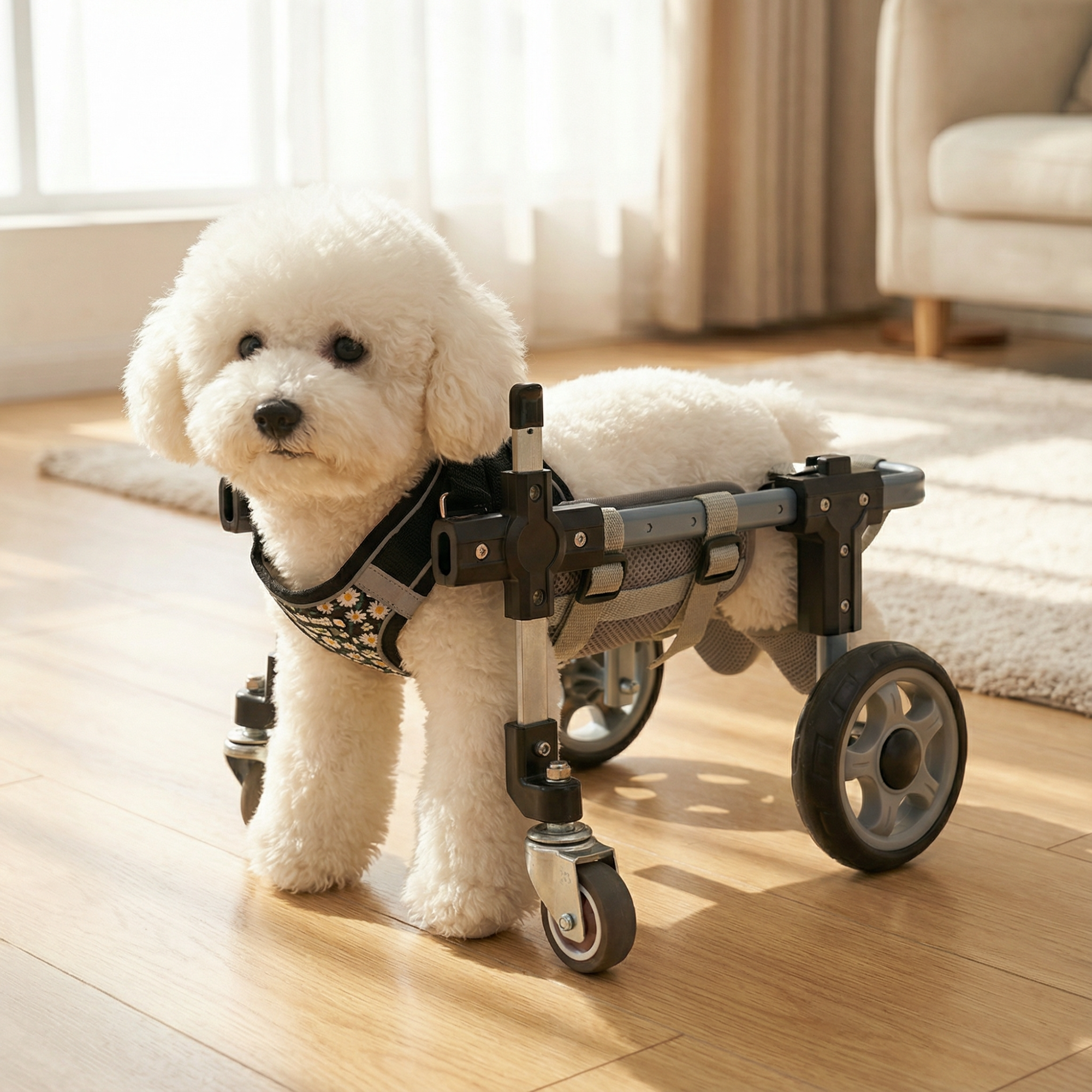
If your dog is weak at both ends, poor balance is the real problem, or a standard rear cart will not be enough, this is the more honest buy. And right now, the price point is still lower than many specialist full-support alternatives.
| Size | Body length | Chest girth |
|---|---|---|
| XS | 22–27 cm / 8.7–10.6 in | 32–37 cm / 12.6–14.6 in |
| S | 26–31 cm / 10.2–12.2 in | 32–37 cm / 12.6–14.6 in |
| M | 30–37 cm / 11.8–14.6 in | 36–46 cm / 14.2–18.1 in |
| L | 38–46 cm / 15.0–18.1 in | 42–55 cm / 16.5–21.7 in |
4) Best low-cost front-support option: Dog Wheelchair for Front Legs
Current price: $199.99

Front-leg cases are where people often waste money. They buy a rear cart because those are more common, then discover it does not solve the actual problem. If your dog’s back legs are still strong but the front end is collapsing or weak, this is the right budget path.
| Size | Back height (floor to top of chest/back) | Chest girth |
|---|---|---|
| S | 9.4–13.0 in / 24–33 cm | 15.0–19.7 in / 38–50 cm |
| L | 9.4–13.0 in / 24–33 cm | 18.9–24.4 in / 48–62 cm |
5) Best “I’m not fully sure yet” option: Universal Dog Wheelchair for Front or Rear Legs
Current price: $299.99

This is not the cheapest option in absolute dollars, but it can be the cheapest mistake-avoiding option if your dog’s rehab situation is changing and you want one frame that can switch between front-leg and rear-leg support.
Ways to Pay Less Without Gambling on Fit

1) Use the official size tools before you order. Dog Wheelchair’s Fit & Sizing Center and its step-by-step measuring guide are the fastest way to avoid paying return fees, wasting time, or ending up with a cart that rubs.
2) Buy the smallest amount of support that still solves the real problem. Rear-support is usually cheaper than full-support, and a lift harness is cheaper than a cart. But only do this if it matches your dog’s actual weakness pattern.
3) Check used and refurbished before you go custom. UsedDogWheelchairs and refurbished specialist models are worth checking when money is tight. Just be much stricter about measurements. Used marketplace | Refurbished example
4) Apply for help if money is the only thing stopping you. The Handicapped Pets Foundation donates new or reconditioned wheelchairs to pets in need, and Joey’s PAW provides financial support for mobility devices.
5) Ask whether insurance can help. Trupanion states that medically necessary mobility devices can be covered for eligible conditions when approved by a veterinarian. That will not apply to everyone, but if you already carry coverage, it is worth checking before you pay out of pocket. Trupanion guide
Mistakes That Make a “Cheap” Wheelchair Expensive

- Buying by breed instead of measurements. Dogs of the same breed can size out very differently. Dog Wheelchair’s sizing center says it plainly: use measurements, not breed assumptions. Sizing center
- Choosing rear support when the dog actually needs front or full support. That is the fastest way to spend money twice. Best Friends
- Ignoring fit checks after the cart arrives. A level-looking frame, clear armpits/groin, and no lingering red marks matter more than “the dog tolerated it for five minutes.” Weight distribution check
- Starting with long sessions. Dog Wheelchair’s rear-support product guidance says to start with short 10–20 minute sessions a few times a day and watch comfort, rubbing, and fatigue. That is smarter than pushing a dog into a long first walk. Rear-leg product page
- Trying to “save money” by skipping the vet when the weakness is sudden or painful. AKC and Trupanion both point owners back to the veterinarian when deciding what kind of mobility device is appropriate. AKC | Trupanion
My plain-English take: the cheapest good outcome usually comes from buying the right support style at the lowest solid price point — not from chasing the lowest number on the internet.
Helpful Dog-Wheelchair.com Guides Worth Opening Before You Buy

| Guide | Why it matters | Link |
|---|---|---|
| Dog Wheelchair Fit & Sizing Center | Best first stop if you do not know which type or size to choose | Open |
| How to Measure Your Dog for a Wheelchair | Step-by-step measuring guide so you do not guess by breed | Open |
| 2-Wheel vs 4-Wheel Dog Wheelchairs | Useful when you are deciding between rear support and full support | Open |
| Is a Dog Wheelchair Right for My Dog? | Good reality check if you are not sure a cart is the correct next step | Open |
| When Should You Put Your Dog in a Wheelchair? | Helpful for timing and how to introduce one without overdoing it | Open |
| Are Dog Wheelchairs Worth It? | Good for quality-of-life questions and whether the money is justified | Open |
| Dog Stroller vs. Dog Wheelchair | Useful if what your dog really needs is transport, not walking support | Open |
| How Much Does a Dog Wheelchair Cost | Budget-focused read that fits this topic directly | Open |
FAQ
Can I just buy the cheapest dog wheelchair I find?
You can, but that is not usually the cheapest outcome. Fit problems can lead to rubbing, poor posture, and a cart your dog refuses to use. AKC specifically points out that proper fit matters to prevent pain and sores. AKC
Is a used dog wheelchair a good idea?
Yes, it can be — especially if the model matches your dog’s support type and measurements. UsedDogWheelchairs through Walkin’ Pets is one place to look. Just be more careful than usual about size, missing parts, and how adjustable the frame really is. Walkin’ Pets used options
What if I cannot afford a wheelchair right now?
Start with a lower-cost bridge option like a rear lift harness for short support needs, then look at aid routes such as the Handicapped Pets Foundation, Joey’s PAW, or the Walkin’ Pets financial-aid page.
How do I know whether my dog needs rear support, front support, or full support?
Match the cart to the weak end of the body. Rear support is for dogs whose back legs need help but front legs still work well. Front support is for dogs whose front legs are the issue. Four-wheel support is for dogs with weakness at both ends or poor overall balance. Best Friends overview
Can dogs pee and poop in a wheelchair?
Often, yes. Dog Wheelchair’s rear-leg, front-leg, and full-support product pages all describe bathroom-friendly open areas in the design. As always, correct height and strap position matter. Rear-support | Front-support | 4-wheel
How long should my dog stay in a wheelchair at first?
Start short. Dog Wheelchair’s rear-support guidance says to begin with 10–20 minute sessions a few times a day, then increase gradually as your dog shows comfort and confidence. Rear-support product page
Final Take
If someone asks me, “Where can I get a dog wheelchair for low cost?” my answer is this:
Start with the right category, not the lowest number. For many dogs with rear-leg weakness, Dog Wheelchair’s rear-support cart is one of the most budget-friendly current official options I’d look at first. If you only need temporary lifting help, the rear lift harness is the lowest-cost bridge tool in this group. If your dog needs all-around stability, the current 4-wheel cart price is still relatively accessible compared with many specialist full-support listings.
And if the budget is truly the wall, do not stop at shopping. Check aid programs, used/refurbished routes, and any insurance possibilities you may already have.
0 comments