

Last updated: July 30, 2026
A senior dog slipping on hardwood floors may need more than a pair of socks. The safest solution is usually a combination of better floor traction, trimmed nails and paw hair, easier routes through the home, appropriate physical support, and veterinary attention when the change is new or worsening.
Quick Answer
Start by creating a continuous non-slip path between your dog’s bed, water, food, favorite resting area, and potty door. Use rubber-backed runners, low-pile mats, or secured yoga mats rather than scattered rugs that can slide or bunch.
Keep nails short and trim excess fur between the paw pads so the pads can contact the floor. For dogs that need occasional help, use a padded rear lift harness. A rear-support wheelchair may be appropriate when the front legs remain strong but the back legs cannot safely support daily movement. Dogs that wobble or have weakness in both the front and back legs may need full-body support.
Contact a veterinarian promptly if the slipping started suddenly, your dog cries out, cannot stand, drags or knuckles a paw, loses bladder or bowel control, develops a head tilt, or becomes unusually weak.

Why Is My Dog Slipping on Hardwood Floors?
Hardwood removes much of the traction a dog normally gets from soil, grass, carpet, or textured pavement. A younger dog can often compensate with muscle strength, fast balance corrections, and confident foot placement. A senior or disabled dog may not have the same reserve.
The problem is often most noticeable when a dog first stands up, turns around, lowers into a squat, stops at a doorway, or tries to accelerate. These movements demand more control than walking in a straight line.
| Possible factor | What you may notice | Why hardwood makes it worse | Practical next step |
|---|---|---|---|
| Long nails | Nails click loudly; paws slide outward while standing | Long nails can reduce the amount of paw pad touching the floor | Ask a groomer or veterinary professional to establish a safe trimming schedule |
| Excess fur between paw pads | Feet appear fluffy underneath; pads are partly covered | Hair contacts the floor instead of the naturally textured paw pads | Carefully trim pad-level fur without cutting skin or digging between toes |
| Osteoarthritis or joint pain | Slow rising, stiff gait, reluctance to turn, climb, or jump | Pain can shorten the stride and reduce the dog’s ability to correct a slip | Arrange a veterinary evaluation and add traction immediately |
| Age-related muscle loss | Thinner thighs, rear-end fatigue, difficulty standing for long periods | Less muscle strength is available to stabilize the hips and knees | Discuss weight, nutrition, pain, and an appropriate conditioning plan with your veterinarian |
| Neurologic weakness | Knuckling, crossing legs, dragging nails, swaying, delayed paw placement | The dog may not place or correct the feet quickly enough | Seek veterinary assessment rather than treating it only as a flooring problem |
| Vision loss | Hesitation at dark floors, thresholds, shadows, or unfamiliar rooms | Shiny floors and reflections can make changes in surface harder to judge | Add lighting, preserve familiar routes, and remove clutter |
| Previous fall and fear | Freezing at the edge of the floor, rushing, refusing to cross a room | Tension and fast, panicked movement can create another slip | Cover the route and rebuild confidence with short, rewarded crossings |
| Weakness in multiple limbs | Front feet also slide; dog tips or collapses even when the rear is lifted | The dog has no stable end of the body to recover balance | Ask whether full-body support is safer than a rear-only sling or cart |
Veterinary reading: VCA Animal Hospitals: Pain in Aging Dogs, American College of Veterinary Surgeons: Osteoarthritis in Dogs, and Cornell University: Degenerative Myelopathy.
When Is Slipping a Medical Concern?
Gradual difficulty on slick floors is common in older dogs, but it should not automatically be dismissed as normal aging. Avoiding slippery floors, taking longer to rise, sitting to one side, and refusing stairs can all be signs of pain.
Seek urgent veterinary help when slipping is accompanied by:
- Sudden inability to stand or walk
- Severe pain, crying, trembling, or resistance to being touched
- A leg that will not bear weight
- Knuckling, paw dragging, or rapidly worsening coordination
- Loss of bladder or bowel control
- Repeated straining without producing urine
- Head tilt, circling, rapid eye movement, vomiting, or sudden loss of balance
- Difficulty breathing, collapse, pale gums, or extreme weakness
- A recent fall, jump, collision, or possible spinal injury
Do not force a suddenly weak dog to walk to “test” the legs. Limit movement, block access to stairs, and contact a veterinary clinic for instructions.
When the change is gradual, schedule a regular veterinary appointment rather than relying only on rugs or grip products. Arthritis, hip and knee problems, spinal disease, muscle loss, foot injuries, and neurologic disorders can look similar at home but require different treatment plans.
What to Do Today: The First 30 Minutes
You do not need to cover every square foot of hardwood immediately. Start by reducing the highest-risk movements.
Immediate home safety checklist
- Block stairs and rooms where your dog regularly falls.
- Place a secured mat beside the bed so all four paws land on traction when standing.
- Create a non-slip strip from the bed to the water bowl and potty exit.
- Move food and water away from tight corners that require a sharp turn.
- Place a wide mat under and around the bowls, not only directly beneath them.
- Remove loose rugs that slide, curl, or bunch under the dog.
- Dry wet paw prints, spills, cleaning residue, and water around bowls immediately.
- Use a rear support sling for necessary crossings if the hind legs collapse.
- Record a short video of the dog rising, walking, turning, and stopping for the veterinarian.
Build a Traction Route Instead of Scattering Rugs
A traction route is a connected path that allows the dog to complete essential daily activities without stepping across uncovered hardwood. This approach is often more effective and more affordable than trying to carpet the entire home.
Map the route from your dog’s point of view
Watch one complete trip from the sleeping area to the potty door. Do not guide the dog unless needed for safety. Note exactly where the feet slide.
- Launch points: beside the bed, crate, couch, or favorite resting spot
- Turn points: hallway corners, kitchen islands, and furniture edges
- Thresholds: doorways and transitions between flooring materials
- Stop points: food bowls, water bowls, doors, and gates
- Posture points: the outdoor potty area and the indoor area where a sling is attached
Widen the traction surface at these locations. A narrow runner may work in a straight hallway, but a dog that swings the rear legs during a turn needs more lateral space.
What makes a safe floor covering?
- A non-slip or rubber backing that stays flat on the floor
- A low, predictable edge that does not catch dragging toes
- Enough width for the dog’s natural stance and turning pattern
- A surface that remains grippy when paws are slightly damp
- Washability if the dog has urinary or bowel accidents
- No loose loops that can catch nails, braces, or dragging paws
Use rug tape or a hardwood-compatible anti-slip underlay when the backing alone is not secure. Confirm that any adhesive is suitable for the floor finish before installation.
Improve Natural Traction: Nails, Paw Hair, and Paw Pads
Keep nails at a functional length
When nails are too long, the toes may be pushed upward and less paw pad may contact the floor. A dog whose nails have been long for months may have an extended quick, so aggressive trimming can cause pain and bleeding. Ask a groomer or veterinary professional about gradual, frequent trimming.
Trim fur level with the paw pads
Long hair growing over the pads can act like a slippery layer. Use blunt-tip grooming scissors or pet clippers only if your dog remains still and you can clearly see the working area. Do not cut deeply between the pads.
Keep the paws clean and dry
Snow treatment, paw balm, floor cleaner, water, and natural skin oils can all change traction. Wipe and dry the paws after outdoor trips. Avoid applying oily products immediately before the dog walks across hardwood.
Check for pain before adding grip products
Inspect for torn nails, pad cuts, redness between the toes, swelling, heat, foreign objects, and licking. A dog may place a painful foot incorrectly, making the slipping appear to be a traction-only problem.
Best Traction Options for Senior and Disabled Dogs
No single option works for every dog. Choose based on where the dog slips, whether the dog tolerates something on the feet, and whether the main problem is traction, weakness, pain, or balance.
| Traction option | Best use | Main advantage | Limitations and safety checks |
|---|---|---|---|
| Rubber-backed runners | Permanent paths through hallways and living areas | Does not require wearing anything on the dog | Edges must stay flat; narrow runners may not provide enough turning room |
| Secured yoga mats | Temporary routes, bedside areas, and rehabilitation spaces | Easy to place and usually provides good grip | Some mats stretch, curl, or slide unless secured; damaged foam may be chewed |
| Low-pile washable mats | Food stations, potty doors, and accident-prone areas | Easier to clean than permanent carpet | Backing must remain non-slip after washing |
| Non-slip dog socks | Dogs that tolerate foot coverings and need short indoor use | Can provide grip without changing the floor | Socks can twist, bunch, trap moisture, restrict circulation, or be chewed; check fit frequently |
| Dog boots | Indoor and outdoor protection when properly fitted | May combine traction with paw protection | Some dogs lift their feet abnormally or become less stable; remove after use and inspect skin |
| Nail grip devices | Dogs that need traction but resist socks | Leaves the paw pads uncovered | Correct sizing and nail length matter; inspect nails and toes regularly |
| Adhesive paw-pad grips | Short-term indoor use for suitable dogs | Low-profile grip under the paw | May loosen with moisture, collect debris, or irritate sensitive skin |
| Padded rear lift harness | Short crossings, stairs, getting up, and potty trips | Adds physical support rather than relying on grip alone | Requires caregiver assistance and is not a substitute for independent daily mobility |
| Rear-support wheelchair | Weak or paralyzed hind legs with functional front legs | Supports the rear body during longer movement sessions | Not for stairs or unsupervised use; correct fit and front-leg strength are essential |
| Four-wheel mobility cart | Weakness at both ends, poor balance, or frequent tipping | Provides front and rear stability | Requires more fitting and space; use only on flat, stable surfaces |
Home modifications such as non-slip rugs, yoga mats, ramps, and supportive harnesses are also discussed in the AAHA senior pet guidance.
Help the Movements Most Likely to Cause a Fall
Getting up from bed
- Place a wide, secured mat under the front half of the bed and extending beyond it.
- Encourage the dog to roll into a chest-down position before standing.
- Use a padded support harness to steady the hips if the rear feet slide backward.
- Lift only enough to prevent collapse; do not pull the dog abruptly upward.
Turning around
Give the dog a wide turning area. Tight U-turns between furniture can cause the rear legs to cross or slide sideways. Move bowls, beds, and furniture so the dog can make a gradual arc.
Stopping at a door
Place traction on both sides of the threshold. Dogs often slip while waiting for the door to open or stepping from one surface to another.
Eating and drinking
Cover enough floor for all four feet and a small step backward. A mat only beneath the bowls does not help when the dog’s rear feet are on hardwood.
Going potty
A dog with weak back legs may reach the potty area but be unable to remain standing or hold a normal squat. A rear sling can help stabilize the hips while leaving the genitals and anus unobstructed. See the complete guide to helping a dog with weak back legs go potty.
When Floor Traction Is Not Enough
Rugs can prevent the paws from sliding, but they cannot restore missing strength, nerve control, or pain-free joint movement. Watch how much physical help your dog needs after the floor is covered.
| What your dog can do | What happens on a traction surface | Support to discuss |
|---|---|---|
| Walks independently but occasionally slides | Movement becomes stable after adding runners and paw care | Environmental changes may be enough, with veterinary assessment if the change is new |
| Walks but needs brief help rising or crossing a room | Rear end dips or tires even with good traction | Padded rear lift harness or support sling |
| Front legs are strong; rear legs drag, buckle, or fatigue quickly | Dog still wants to move but cannot keep the hips supported | Rear-support or two-wheel dog wheelchair |
| Rear legs work, but front legs are weak or injured | Dog falls forward or cannot safely load the front limbs | Front-support cart after veterinary guidance |
| Both front and rear legs are weak | Dog tips, sways, or collapses despite rear support | Four-wheel full-support mobility cart |
| Dog cannot walk and has sudden pain or sudden paralysis | Movement changed abruptly | Urgent veterinary care before selecting mobility equipment |
The correct cart depends on which legs still provide reliable strength. Use the Dog Wheelchair Fit & Sizing Center to compare rear, front, and full-support options using measurements rather than breed alone.
Dog-Wheelchair.com Mobility Options by Support Level
These products address different stages of mobility loss. The most supportive product is not automatically the best product. Choose the lowest level of support that keeps your dog safe, balanced, comfortable, and able to move naturally.
Product prices and published specifications were checked on July 30, 2026. Confirm current price, stock, size availability, and fit information on the live product page before ordering.

Dog Rear Lift Harness – Hind Leg Support Sling
This is the practical starting point when a senior dog can still walk but needs hands-on help standing, crossing a slippery area, using stairs, entering a vehicle, or completing a potty trip.
- Published price: $59.99 USD sale price; $99.99 regular price
- Available sizes: S, M, L, and XL
- Published weight range: 16.5–99.2 lb, depending on size
- Waist range: 13.0–33.5 inches across available sizes
- Materials and features: perforated neoprene, soft lining, adjustable closure, reflective details, and padded lifting handle
- Best use: short assisted sessions rather than all-day wear

Adjustable Dog Wheelchair for Back Legs
Consider this rear-support cart when a small dog’s front legs can still pull and steer, but the back legs cannot provide enough support for safe daily movement.
- Published price: $149.99 USD
- Published sizes: Small, Medium, and Large
- Recommended pet weight: up to 22 lb
- Frame material: aluminum
- Published item weight: 2.2 lb
- Published item dimensions: 12 × 9.5 × 3.5 inches
- Warranty: one year
This model is not the right choice when the front legs are also weak, the dog tips forward, or the dog cannot safely steer a rear-only cart.
View the Rear-Leg Wheelchair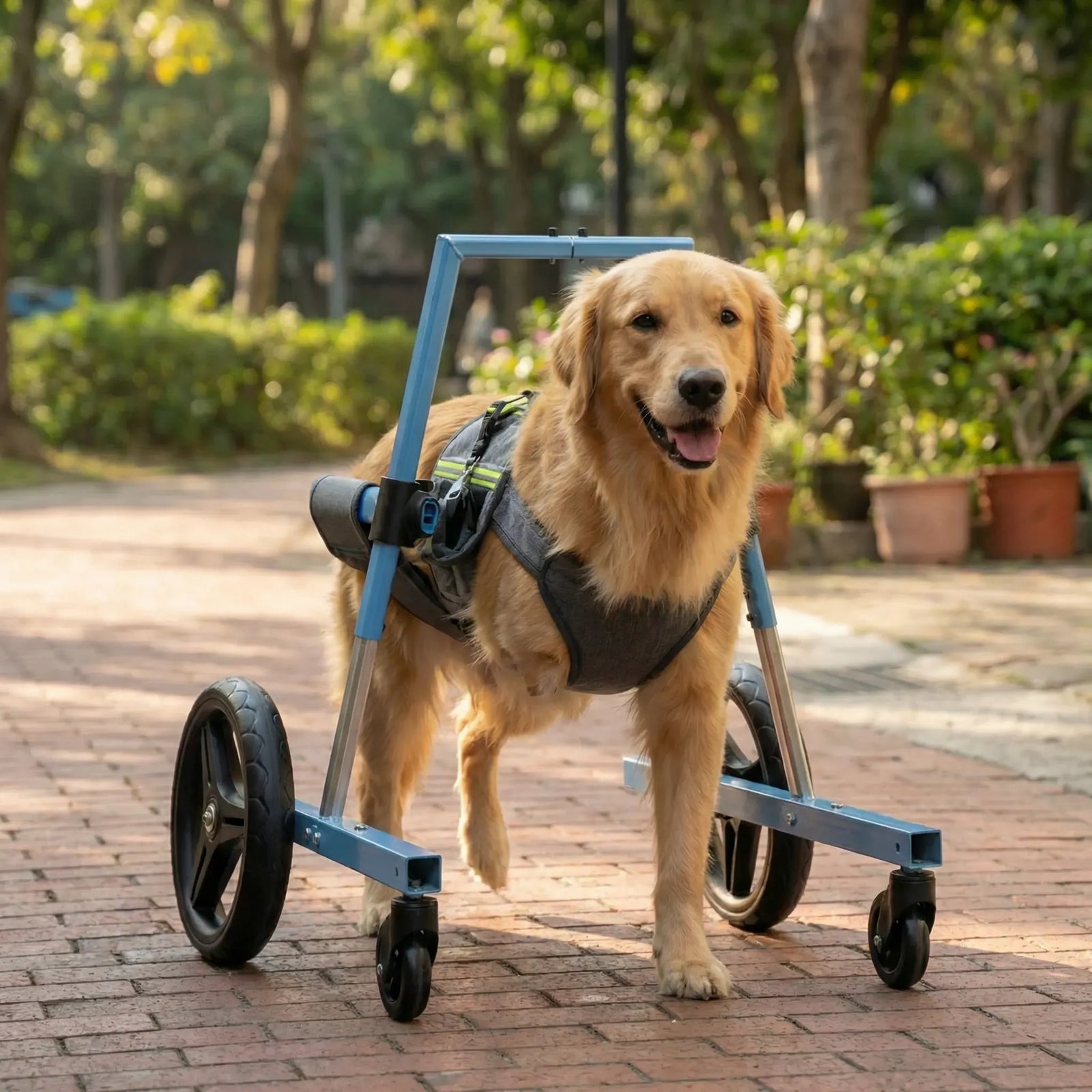
Universal Dog Wheelchair for Front or Rear Legs
This two-in-one design can be configured for front-leg support or rear-leg support by changing the wheel position. It may suit households that need a broader size range or dogs whose support needs may change during rehabilitation.
- Published price: $299.99 USD sale price; $399.99 regular price
- Available sizes: XS through XXL
- Published frame weight: approximately 2.6–7.7 lb, depending on size
- Frame: hollow aviation aluminum with laser-welded construction
- Adjustment: push-button height adjustment
- Comfort feature: anti-chafe guards around sensitive contact areas
Breed examples on the product page are references only. Measure the individual dog before choosing a size.
View the Universal Wheelchair
4-Wheel Dog Wheelchair, Full Support Cart
A four-wheel cart provides support at both ends of the body. It is the more appropriate starting point when a dog wobbles, tips, has weakness in multiple limbs, or cannot remain balanced in a rear-only wheelchair.
- Published price: $187.99 USD
- Available sizes: XS, S, M, and L
- Frame: lightweight aluminum alloy
- Support: padded front and rear harnesses supporting the chest and hips
- Adjustment: height, length, and width adjustable
- Use environment: flat indoor floors, sidewalks, and short grass with supervision
- Bathroom design: open rear and underside areas intended to preserve normal urination and defecation
Do not use a dog wheelchair on stairs, steep slopes, or rough terrain. Begin with short supervised sessions and check the skin after use.
View the Full-Support WheelchairRoom-by-Room Mobility Plan
| Area | Main risk | Recommended change | Fit or maintenance check |
|---|---|---|---|
| Sleeping area | Sliding while rising; falling off a high bed | Use a low orthopedic bed with a wide secured mat beneath and around it | Make sure the bed does not slide when the dog pushes against it |
| Hallway | Narrow path and uncovered gaps | Install a continuous low-pile runner with flat edges | Check weekly for curling, bunching, and movement |
| Kitchen | Spills, fast turns, and slick cleaning residue | Limit access during cooking and cleaning; create a dry traction lane | Confirm floor products do not leave a slick film |
| Food and water station | Rear feet slipping while the head is lowered | Use a wide washable mat extending beyond all four feet | Dry water spills immediately and wash the backing regularly |
| Doorway | Stopping, waiting, and stepping over a threshold | Place traction on both sides of the doorway | Keep the threshold visible and free of loose rug edges |
| Stairs | Major fall risk | Use secure gates and provide an alternate route whenever possible | Do not allow wheelchair use on stairs |
| Bathroom or utility room | Wet floors and hard surfaces | Restrict access unless the floor is dry and covered | Use washable, moisture-resistant traction materials |
| Outdoor potty area | Uneven ground, mud, ice, or difficulty holding posture | Choose a short, flat, well-lit route with stable footing | Use a rear sling when needed and keep bathroom openings unobstructed |
| Vehicle entry | Jumping, twisting, and caregiver lifting injury | Use a stable ramp or appropriate lifting harness | Confirm the ramp has a non-slip surface and cannot shift |
A Seven-Day Plan to Reduce Slipping
This plan is designed for a dog whose condition is stable and has no urgent warning signs. It does not replace veterinary diagnosis or rehabilitation instructions.
| Day | Action | What to record |
|---|---|---|
| Day 1 | Film the dog rising, walking, turning, eating, and going through a doorway. Block high-risk areas. | Which legs slip, where it happens, whether pain or knuckling is visible |
| Day 2 | Create one connected traction route from bed to water and potty exit. | Number of slips on the same route before and after covering it |
| Day 3 | Inspect nails, paw hair, pads, and skin. Arrange professional grooming if needed. | Clicking nails, covered pads, redness, torn nails, licking, or swelling |
| Day 4 | Widen traction at turns, bowls, doors, and the bedside launch area. | Whether slipping happens during straight walking, turning, standing, or stopping |
| Day 5 | Test appropriate short-term support, such as a rear lift harness, with supervision. | How much lifting is required and whether the front legs remain stable |
| Day 6 | Review bathroom access, stairs, vehicle entry, and favorite resting areas. | Tasks the dog avoids or cannot complete without help |
| Day 7 | Compare the videos and slip record. Share meaningful changes with the veterinarian. | Improvement, no change, worsening weakness, fatigue, pain, or new neurologic signs |
Use a simple slip log
Record the location, movement, affected legs, and recovery after each slip. This is more useful than writing only “had a bad day.”
| Time and location | Movement | What happened | Recovery |
|---|---|---|---|
| Example: Morning, beside bed | Standing up | Both rear feet slid backward | Needed rear lift assistance |
| Example: Afternoon, kitchen doorway | Turning right | Left rear paw crossed under body | Recovered independently after two seconds |
| Example: Evening, water bowl | Standing with head lowered | Rear legs gradually spread apart | Could not recover until supported |
Patterns help distinguish a general traction problem from rear weakness, one-sided pain, fatigue, or poor coordination.
Common Mistakes That Can Make Slipping Worse
Using small, unsecured rugs
A loose rug can move faster than the dog can correct. Secure every floor covering and remove any rug that curls or slides.
Covering only the middle of the room
Slips often occur while getting up, turning, waiting at doors, or lowering the head to eat. Cover these transition zones first.
Assuming socks will solve weakness
Grip socks may help a dog with stable legs, but they cannot support collapsing hips or poor neurologic control. Twisted socks can also create a new hazard.
Pulling up by a collar or regular walking harness
Standard collars and many everyday harnesses are not designed to lift body weight. Use a mobility support device that distributes pressure appropriately.
Choosing a rear wheelchair when the front legs are weak
A rear cart transfers more of the movement and steering work to the front limbs. A dog that falls forward, has shoulder weakness, or tips in a rear cart may need full-body support.
Starting with long wheelchair sessions
The first goal is comfort and confidence, not distance. Introduce the cart on a flat, non-slip surface and inspect the armpits, chest, belly, groin, and hips afterward.
Letting a dog drag across hardwood
Dragging can scrape paws, knees, hocks, hips, and other contact areas. Read how to prevent sores when a dog drags the back legs for a daily skin and equipment checklist.
Treating a sudden change as normal aging
New weakness, limping, pain, knuckling, or inability to stand needs veterinary attention. A mobility product should not hide a potentially urgent condition.
Frequently Asked Questions
Why is my old dog suddenly slipping on hardwood floors?
Sudden slipping may be caused by pain, a paw or nail injury, knee or hip injury, spinal disease, vestibular problems, neurologic weakness, or another illness. Restrict risky movement and contact a veterinarian, especially if the dog is painful, knuckling, dragging a limb, falling repeatedly, or unable to stand.
What can I put on hardwood floors to stop my dog from slipping?
Use secured rubber-backed runners, low-pile washable mats, or secured yoga mats to create a continuous route. The covering should stay flat, provide enough width for turning, and have no exposed gaps where a weak paw can land.
Do long nails make dogs slip?
Long nails can change foot position and reduce paw-pad contact with the floor. If the nails click loudly on hardwood, ask a groomer or veterinary professional whether gradual trimming could improve function.
Should I trim the fur between my dog’s paw pads?
Fur that extends over the pads can reduce natural grip. Trim it level with the pads only when you can do so safely. Do not cut deeply between the toes, and seek professional grooming help if your dog moves or has sensitive feet.
Are grip socks safe for senior dogs?
Properly fitted grip socks can help some dogs during supervised indoor use. They are not safe when they twist, bunch, become wet, restrict circulation, irritate the skin, or cause an abnormal gait. Remove them regularly and inspect every foot.
Why does my dog slip more when standing up?
Rising requires the dog to shift weight, bring the feet under the body, and generate force before forward movement begins. Pain, weak hind legs, poor coordination, and a bed that slides can make this launch phase especially difficult.
Can arthritis cause a dog to slip on hardwood?
Yes. Arthritis can cause pain, stiffness, reduced range of motion, a shorter stride, and difficulty rising. These changes can reduce the dog’s ability to maintain or recover traction. A veterinarian can assess the joints and recommend an appropriate pain and mobility plan.
When should I use a rear lift harness?
Use a rear lift harness when the dog needs short, hands-on assistance getting up, crossing a slick surface, using steps, entering a vehicle, or remaining stable during a potty break. It should support the hindquarters without pressing into sensitive areas or blocking urination and defecation.
When does a slipping dog need a wheelchair?
A wheelchair may be appropriate when traction improvements and a lift harness do not provide enough support for safe daily movement. A rear cart generally requires functional front legs. A four-wheel cart may be more suitable when both ends of the body are weak or the dog tips over.
Can a dog wheelchair be used on hardwood floors?
Many dog wheelchairs can be used on flat indoor floors, but the route should be clear, dry, and supervised. Wheel traction, turning space, frame alignment, and harness fit all matter. Do not use the cart on stairs or steep surfaces.
Should I exercise a senior dog that keeps slipping?
Appropriate low-impact activity can help preserve mobility, but the plan should match the dog’s diagnosis and current ability. Do not begin strengthening exercises when weakness is sudden, painful, or unexplained. Ask your veterinarian or canine rehabilitation professional for safe activities and surfaces.
How can I tell whether the problem is the floor or my dog’s legs?
Observe the dog on a secured traction surface. A dog that becomes stable may mainly need environmental changes, although a new change still deserves attention. A dog that continues to buckle, cross the legs, drag paws, sway, or collapse likely needs medical assessment and possibly physical support.
Choose Support Based on the Legs That Are Still Strong
Start with your dog’s actual movement pattern: occasional slipping, weak back legs, front-leg weakness, or full-body instability. Then measure carefully before selecting a harness or wheelchair.
Get the Fit and Sizing Guide View Back-Leg Wheelchairs View Full-Support Wheelchairs View Mobility Accessories