

When a dog loses the ability to walk normally, see clearly, hear familiar sounds, or control part of the body, families often ask the same painful question: Can my disabled dog still be happy?
The direct answer
Yes, many disabled dogs are genuinely happy. A disability changes how a dog moves through the world, but it does not automatically remove the ability to enjoy food, affection, sniffing, play, outdoor time, companionship, or a familiar daily routine.
The more useful question is not, “Can my dog walk normally?” It is: Is my dog comfortable, engaged, able to participate in daily life, and having more good days than bad?
A disabled dog may have a good quality of life when pain is controlled, eating and drinking remain normal, toileting is manageable, rest is comfortable, and the dog still seeks out people, activities, scents, treats, toys, or other familiar pleasures.
Disability alone is not proof of suffering. Persistent pain, breathing distress, repeated injuries, inability to rest, loss of appetite, severe toileting problems, or ongoing withdrawal are much more important warning signs.

Disability Is Not the Same as Suffering
People naturally imagine disability through a human lens. We picture everything the dog has lost and may assume the dog is constantly comparing the present with life before the disability.
Dogs usually respond more directly to what is happening now. Can they get comfortable? Can they reach food and water? Can they go outside? Can they stay near their family? Can they investigate an interesting smell? Can they move without repeated pain, slipping, or panic?
Veterinary guidance recognizes that pets with disabilities can maintain a good quality of life when their physical needs, emotional needs, environment, and daily activities are properly supported. VCA notes that advances in veterinary care and home management allow many disabled pets to have a normal or nearly normal life expectancy with good quality of life.
A 2024 caregiver-reported study of assistive mobility carts found that 62% of respondents reported improved quality of life for the animal and 61% reported improved quality of life for the caregiver. The same research also reported complications, including skin wounds, which shows why proper fit and monitoring matter.
Read the research: Caretaker-reported quality of life and assistive mobility carts.
A useful mindset shift
Do not judge your dog’s life by how closely it resembles an able-bodied dog’s life. Judge it by whether your dog can still experience comfort, choice, connection, and enjoyable daily moments.
Signs a Disabled Dog Is Still Happy
One tail wag or one difficult morning cannot tell you everything. Look for patterns across several days and across different parts of the day.
| Area | Encouraging signs | Concerning changes | What to check next |
|---|---|---|---|
| Comfort | Settles into sleep, accepts gentle touch, rests without constant repositioning | Trembling, crying, guarding, hunched posture, inability to settle | Ask the veterinarian whether pain control or positioning support needs to change |
| Appetite | Shows interest in meals, treats, or familiar food routines | Repeatedly refuses food, appears nauseated, or loses weight | Check bowl access, dental discomfort, medication effects, and underlying illness |
| Social connection | Seeks attention, follows family activity, relaxes near familiar people | Persistent hiding, withdrawal, irritability, or no response to favorite people | Look for pain, fatigue, anxiety, cognitive changes, or overstimulation |
| Interest in life | Sniffs outside, watches activity, responds to toys, treats, touch, or routines | No interest in previously valued activities over several days | Offer lower-effort activities and discuss persistent withdrawal with a veterinarian |
| Mobility | Moves willingly with appropriate assistance and recovers comfortably afterward | Repeated falls, panic, collapse, dragging wounds, or exhaustion after short activity | Shorten sessions and reassess pain, equipment type, fit, surface, and stamina |
| Toileting | Can urinate and defecate with manageable assistance and stays reasonably clean | Straining, inability to urinate, repeated soiling, urine scald, or distress | Contact a veterinarian promptly, especially for little or no urine |
| Good days | Most days contain several comfortable, enjoyable moments | Bad days increasingly outnumber good days | Begin a written quality-of-life log and arrange a veterinary review |
These observations are designed to reveal trends. They do not replace diagnosis or individualized veterinary care.
The Comfort, Agency, and Connection Test
Happiness is difficult to measure with one behavior. A practical way to evaluate a disabled dog is to look at three areas together.
1. Comfort: Can the dog feel physically at ease?
Comfort comes first. A dog cannot enjoy mobility equipment, enrichment, or family time if pain, breathing difficulty, skin sores, nausea, or constant fatigue remain uncontrolled.
- Can the dog sleep and settle?
- Can the dog change position without obvious distress?
- Are harness and wheelchair contact areas free from redness, heat, swelling, or broken skin?
- Does the dog recover normally after activity?
2. Agency: Can the dog make choices and do dog things?
Agency means having some control over the day. A dog may need help walking but can still choose which direction to sniff, whether to greet someone, which resting place to use, or when to pause.
- Can the dog move toward something interesting?
- Can the dog move away from something uncomfortable?
- Can the dog participate instead of always being carried or left behind?
- Does support equipment increase freedom rather than simply keep the dog upright?
3. Connection: Does the dog remain engaged with family and surroundings?
Dogs are social animals. Quiet companionship can be meaningful even when energetic play is no longer possible.
- Does the dog relax near family members?
- Does the dog respond to touch, visual signals, scent, food, or familiar routines?
- Does the dog still show anticipation before meals, outdoor time, or visits from familiar people?
- Are there still moments that clearly feel enjoyable to the dog?
The most important insight
Mobility is one part of quality of life, not the whole of quality of life. A dog may move poorly and still be comfortable and engaged. Another dog may still be able to walk but experience uncontrolled pain, fear, or severe illness.
How Different Disabilities Affect a Dog’s Happiness
“Disabled dog” is a broad description, not a diagnosis. The support that helps one dog may be irrelevant or unsafe for another.
| Disability or limitation | What often affects quality of life | Helpful support | Reliable source |
|---|---|---|---|
| Rear-leg weakness or paralysis | Falling, dragging injuries, difficulty toileting, inability to reach favorite places | Non-slip flooring, rear lift harness, rear-support wheelchair, skin checks | Dogs With Mobility Issues |
| Front-leg weakness | Chest collapse, face-first falls, shoulder fatigue, inability to steer a rear cart | Front-support cart or full-support cart, depending on rear-leg strength and balance | Fit & Sizing Center |
| Weakness in all four limbs | Poor balance, tipping, rapid fatigue, inability to stay upright | Four-wheel full-body support, short supervised sessions, veterinary rehabilitation plan | Official 4-Wheel Cart Page |
| Blindness or low vision | Collisions, uncertainty in new spaces, stairs, unexpected changes in furniture | Consistent room layout, scent and texture cues, leash supervision, protective halo harness | VCA: Pets With Disabilities |
| Deafness | Startling, missed verbal cues, traffic risk, difficulty locating family members | Hand signals, vibration cues, protected outdoor activity, predictable routines | VCA: Living With a Deaf Dog |
| Amputation | Balance changes, fatigue, added load on remaining limbs, slippery flooring | Weight management, traction, controlled exercise, ramps, rehabilitation when advised | Texas A&M: Special-Needs Dogs |
| Progressive neurological disease | Changing mobility, incontinence, muscle loss, fatigue, increasing care needs | Regular reassessment, hygiene support, mobility aids, written good-day/bad-day tracking | PDSA: Degenerative Myelopathy |
A Practical Seven-Day Quality-of-Life Check
Memory is influenced by emotion. One wonderful afternoon can make a difficult week feel better than it was, while one frightening fall can make a generally stable week feel hopeless.
For seven days, record the same observations at roughly the same time. Use 2 for good, 1 for mixed, and 0 for poor.
| Daily category | 2 points | 1 point | 0 points |
|---|---|---|---|
| Comfort | Comfortable at rest and during normal handling | Some stiffness or discomfort but settles with normal support | Ongoing pain, trembling, crying, guarding, or inability to rest |
| Eating and drinking | Normal interest and access | Reduced interest or needs encouragement | Refuses food or water, repeated vomiting, or cannot access bowls |
| Toileting and hygiene | Manageable and reasonably clean | Needs extra assistance or has occasional problems | Straining, inability to urinate, severe soiling, or skin damage |
| Engagement | Interested in people, food, scents, toys, or surroundings | Some interest but less than usual | Persistent withdrawal or no response to favorite activities |
| Mobility and choice | Can participate willingly with suitable assistance | Participation is possible but tiring or inconsistent | Movement causes panic, repeated falls, collapse, or obvious suffering |
| Rest and sleep | Sleeps comfortably and changes position as needed | Some restlessness or needs repositioning | Cannot settle, repeatedly pants at rest, or remains distressed |
| Good-day feeling | The day contained several clearly enjoyable moments | The day was mixed | The day was dominated by distress or discomfort |
The highest daily total is 14. Do not treat one total as a diagnosis or use a rigid cutoff by itself. Look at the direction of the scores and note which category is declining.
- A stable or improving pattern suggests the current care plan may be supporting quality of life.
- A gradual downward trend deserves a veterinary review.
- A sudden zero for breathing, severe pain, collapse, or inability to urinate should not wait for the seven-day review.
For a more detailed worksheet, use the Quality-of-Life Checklist for Mobility Dogs .
Mobility Support Should Solve a Specific Barrier
A wheelchair does not create happiness by itself. The right mobility aid removes a barrier that is preventing the dog from doing something meaningful.
For example, a rear cart may allow a dog with strong front legs to explore the yard without dragging. A four-wheel cart may help a wobbly dog remain upright. A stroller may let a dog enjoy a long family outing without exhausting the body. A halo harness may reduce collisions for a blind dog.
The correct equipment depends on what the dog can still do—not just the diagnosis or breed.
| What your dog can do now | Main barrier | Support to consider | Avoid this mistake |
|---|---|---|---|
| Walks but needs help rising, using stairs, or entering a car | Mild or temporary rear weakness | Rear lift harness | Buying a full cart before confirming that lighter support is insufficient |
| Has strong front legs but weak, dragging, or paralyzed rear legs | Rear support and protection from dragging | Two-wheel rear-support wheelchair | Using a rear cart when the front legs cannot safely power and steer |
| Has strong rear legs but weak or injured front legs | Front-body support | Front-leg wheelchair | Putting pressure on the throat, armpits, or shoulders through poor fit |
| Has weakness at both ends, wobbles, or falls sideways | Whole-body stability | Four-wheel full-support wheelchair | Choosing a rear-only cart because it appears simpler |
| Needs different support as the condition changes | Changing front or rear mobility needs | Universal front/rear 2-in-1 wheelchair | Assuming one setup works without repositioning and refitting the wheels |
| Can walk briefly but cannot manage long outings | Fatigue and energy management | Wheelchair for exercise and stroller for transport | Forcing the dog to walk the full outing because a cart is available |
| Walks independently but collides with objects because of vision loss | Obstacle detection | Blind-dog halo harness | Using the halo unsupervised near stairs or tight hazards |
Not sure where to begin? Complete the Dog Wheelchair Fit & Sizing Center before ordering.
Dog Wheelchair Products Matched to Real Support Needs
The products below are matched by support type, balance, remaining limb strength, and daily use. Prices and specifications were checked on June 15, 2026 and may change.

Dog Rear Lift Harness
Official price checked: $59.99
This is the lighter starting point for dogs that can still walk but need help standing, using stairs, entering a vehicle, or completing short rehabilitation walks.
- Sizes S, M, L, and XL
- Official recommended weight range: 16.5–99.2 lb, depending on size
- Breathable neoprene-style support
- Padded lifting handle and reflective details
- Designed for arthritis, injury, post-surgery recovery, and rear weakness
Adjustable Dog Wheelchair for Back Legs
Official price checked: $149.99
Best for small dogs whose front legs remain strong enough to pull, steer, and control a two-wheel rear cart.
- Current product options: XS, S, and M
- Adjustable frame length and height
- Breathable chest and belly support
- Shock-absorbing rubber wheels
- Reflective strip and quick fastening system

Dog Wheelchair for Front Legs
Official price checked: $199.99
This cart is designed for dogs that need front-body support but can still push and balance with their back legs.
- Sizes S and L
- Back-height range: 9.4–13.0 in
- S chest-girth range: 15.0–19.7 in
- L chest-girth range: 18.9–24.4 in
- Adjustable height, length, and width
- Lightweight aluminum frame with EVA and swivel wheels

4-Wheel Full-Support Dog Wheelchair
Official price checked: $187.99
A four-wheel cart supports the front and rear of the body, making it a better starting point when the dog wobbles, tips over, or cannot safely control a rear-only cart.
- Sizes XS, S, M, and L
- Body-length ranges from 8.7 to 18.1 in, depending on size
- Chest-girth ranges from 12.6 to 21.7 in, depending on size
- Lightweight aluminum-alloy frame
- Padded front and rear harnesses
- Height, length, and width adjustment
- Open underside designed to preserve normal toileting
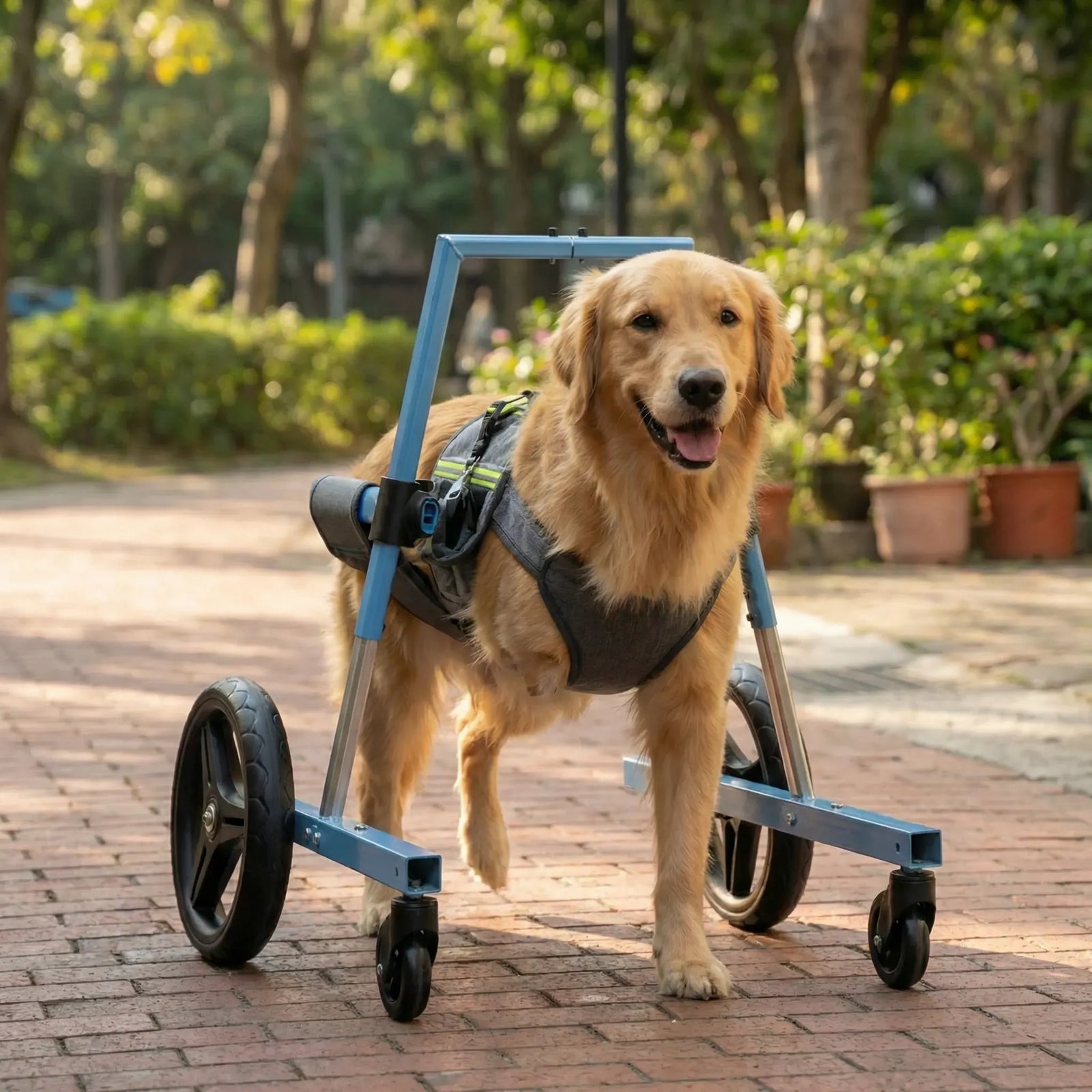
Universal Front/Rear Dog Wheelchair
Official price checked: $299.99
This 2-in-1 design can be configured for front-leg or rear-leg support by changing the wheel positions. It may suit families whose dog’s support needs are changing.
- Sizes XS through XXL
- Approximate frame weights from 2.6 to 7.7 lb
- Hollow aviation-aluminum frame
- Push-button height adjustment
- Dual-bearing shock-absorbing tires
- Padded straps and anti-chafe protection

Adjustable Blind Dog Halo Harness
Official price checked: $89.99
The bumper ring contacts obstacles before the dog’s face, helping reduce collisions while the dog learns to navigate familiar and unfamiliar spaces.
- Sizes S and M
- Recommended weight range: 8.8–39.7 lb, depending on size
- Adjustable halo angle and reach
- Adjustable neck and chest straps
- Reflective trim and foam bumper ring

Foldable 4-Wheel Pet Stroller
Official price checked: $171.72
A stroller is not a replacement for active mobility support. It is useful when a dog still enjoys being outside but cannot safely walk the entire distance.
- Weight capacity up to 50 lb
- Open dimensions: 27.17 × 16.14 × 39.37 in
- Interior carry cot: 22.05 × 13.39 × 10.63 in
- Four swivel wheels, suspension, and rear brakes
- Dual interior leash clips
- Breathable mesh, adjustable canopy, and foldable frame
Official Product Comparison
| Product | Best for | Official size or capacity | Key construction | Price checked June 15, 2026 |
|---|---|---|---|---|
| Rear Lift Harness | Assisted standing, stairs, car entry, rehab walking | S–XL; 16.5–99.2 lb across listed sizes | Breathable neoprene-style support and padded handle | $59.99 |
| Rear-Leg Wheelchair | Small dogs with weak rear legs and strong front legs | Current selector shows XS, S, and M | Adjustable frame, mesh support, rubber wheels | $149.99 |
| Front-Leg Wheelchair | Weak front legs with strong, stable rear legs | S and L; chest girth 15.0–24.4 in across listed sizes | Aviation-grade aluminum, EVA and swivel wheels | $199.99 |
| 4-Wheel Full-Support Cart | Weakness in multiple limbs, poor balance, tipping | XS–L; body length 8.7–18.1 in across listed sizes | Aluminum-alloy frame with front and rear harnesses | $187.99 |
| Universal Front/Rear Cart | Changing or uncertain front/rear support needs | XS–XXL; frame weights approximately 2.6–7.7 lb | Hollow aluminum frame and repositionable wheels | $299.99 |
| Blind Dog Halo Harness | Blind or low-vision dogs that collide with obstacles | S and M; 8.8–39.7 lb across listed sizes | Adjustable foam halo and reflective harness | $89.99 |
| Foldable Pet Stroller | Long outings, vet visits, recovery, low stamina | Up to 50 lb | Four wheels, suspension, brakes, mesh carry cot | $171.72 |
Always use the current product-page size chart rather than choosing by breed alone. Dogs of the same breed can have very different chest girths, body lengths, weights, and balance needs.
Helping a Disabled Dog Adjust to a Wheelchair or Support Device
A dog that freezes during the first fitting is not necessarily rejecting the wheelchair. Straps, wheels, changes in balance, and the sensation of being lifted are unfamiliar.
The goal of the first week is confidence, not distance.
| Stage | Goal | What to do | When to stop |
|---|---|---|---|
| Day 1 | Make the equipment familiar | Let the dog sniff it, place treats nearby, and reward calm investigation | The dog becomes increasingly tense or avoids the area |
| Day 1–2 | Accept brief fitting | Fit the harness for a short period without demanding a full walk | Straps pinch, the dog panics, or posture appears forced |
| Day 2–3 | Take several calm steps | Use a quiet, flat, non-slip surface and reward forward movement | The dog scrambles, twists, repeatedly sits, or becomes distressed |
| Day 3–5 | Build coordination | Add a small amount of distance while keeping sessions successful | Fatigue appears before confidence |
| Day 5–7 | Create a predictable routine | Use short regular sessions and finish while the dog is still comfortable | Skin redness, soreness, worsening gait, or reluctance increases |
Change one challenge at a time. Do not combine a new wheelchair, an unfamiliar location, rough terrain, and a long walk in the same first session.
Read: Are Dogs Afraid of Wheelchairs? and How Long Can a Dog Stay in a Wheelchair? .
Home Changes That Can Make a Disabled Dog Happier
Create traction routes
Place non-slip runners or mats between the dog’s bed, water, food, and potty exit. A few safe paths can matter more than covering the entire house.
Keep important items easy to reach
Move food, water, bedding, and favorite resting places to locations that do not require stairs or slippery turns.
Use low-effort enrichment
Sniffing games, gentle grooming, food puzzles, short outdoor observation, and calm social time allow a dog to enjoy the day without exhausting the body.
Protect skin and paws
Check the armpits, chest, belly, groin, inner thighs, paw tops, and any area touching a harness or cart after each early session.
Preserve a predictable bathroom routine
Offer more frequent potty opportunities, use support equipment when needed, and keep cleaning supplies close enough to prevent prolonged dampness or urine scald.
Plan for both active and low-energy days
A wheelchair may suit short supported exercise, while a stroller may be kinder for a long outing or a flare-up day. Using both is not a failure; it is energy management.
Contact a Veterinarian Promptly If You Notice These Signs
- Sudden inability to stand or walk after the dog was previously stable
- Severe pain, crying, trembling, guarding, or inability to settle
- Breathing distress or abnormal panting while resting
- Straining to urinate, producing very little urine, or producing no urine
- Collapse, seizure, severe weakness, or rapidly worsening neurological signs
- An open pressure sore, bleeding, swelling, heat, or discharge under mobility equipment
- Repeated vomiting, refusal of food, or signs of dehydration
- A wheelchair user suddenly leaning, dragging differently, or refusing movement after previously doing well
Stop using mobility equipment until the cause of sudden pain, distress, or skin injury has been assessed.
When the Question Becomes: “Is My Dog Still Enjoying Life?”
Some disabilities are stable. Others are progressive or occur alongside serious disease. There may come a time when mobility equipment no longer restores comfort or meaningful participation.
The commonly used HHHHHMM framework asks families to consider:
- Hurt: Is pain or breathing distress controlled?
- Hunger: Is the dog eating enough?
- Hydration: Is hydration adequate?
- Hygiene: Can the dog remain clean and dry?
- Happiness: Does the dog still engage with valued people and activities?
- Mobility: Can movement be supported without unacceptable distress?
- More good days than bad: What does the weekly pattern show?
AAHA explains that quality-of-life scales can help families and veterinarians evaluate changes more objectively. Review: How to Assess Your Senior Pet’s Quality of Life .
No online score should make an end-of-life decision for you. Bring your written observations, videos, appetite changes, sleep patterns, toileting difficulties, and good-day/bad-day calendar to your veterinarian.
Disability should not be the deciding label
The decision should be based on whether suffering can still be controlled and whether the dog continues to experience enough comfort, connection, and enjoyment—not simply on whether the dog walks, sees, hears, or toilets without assistance.
Frequently Asked Questions
Do disabled dogs know they are disabled?
Dogs notice physical changes and may feel confusion or frustration, especially after a sudden injury. However, they do not necessarily evaluate themselves through the same social comparisons people use. Most respond to present-day comfort, access, routines, and interaction.
Can a paralyzed dog still be happy?
Yes. A paralyzed dog may still enjoy food, attention, sniffing, play, outdoor time, and family routines. Quality of life depends on pain control, hygiene, bladder and bowel management, skin protection, mobility support, and continued engagement.
Is it cruel to keep a disabled dog alive?
Disability alone does not make continued life cruel. Continuing life becomes concerning when suffering cannot be adequately controlled, essential needs cannot be met, or bad days consistently outnumber good days despite appropriate care.
How do I know whether my disabled dog is depressed?
Persistent withdrawal, loss of interest, sleep changes, reduced appetite, irritability, and refusal of previously enjoyed activities deserve attention. These signs can also result from pain, medication effects, fatigue, cognitive decline, or another medical problem, so a veterinary assessment is important.
Will a wheelchair make my dog happy?
A wheelchair may improve quality of life when lack of safe mobility is the main barrier. It will not correct uncontrolled pain, breathing disease, severe fatigue, anxiety, poor fit, skin wounds, or a cart type that does not match the dog’s weakness pattern.
How can I tell whether a dog wheelchair is helping?
Look for fewer falls, easier bathroom trips, more willingness to go outside, increased sniffing and exploration, comfortable recovery after activity, and healthy skin under the straps. Distance alone is not the best measure.
Should a disabled dog use a wheelchair or a stroller?
A wheelchair supports active movement. A stroller transports the dog with minimal physical effort. Dogs that can manage short supported exercise but tire on longer outings may benefit from both.
Can an old dog be too weak for a wheelchair?
Yes. Very frail dogs, dogs with serious heart or breathing disease, dogs with uncontrolled pain, and dogs that cannot tolerate the posture or effort may not be suitable candidates. Age alone is not the deciding factor; overall health and remaining strength matter more.
How long should a dog stay in a wheelchair?
Begin with short, supervised sessions and increase gradually. Session length depends on the dog’s diagnosis, stamina, skin tolerance, cart type, surface, and fit. Remove the cart for sleep, unsupervised rest, and whenever fatigue or rubbing appears.
Can blind or deaf dogs have happy lives?
Yes. Blind and deaf dogs can enjoy long, full lives when their environment, communication, and safety routines are adapted. Predictable layouts, visual or tactile cues, protected outdoor activity, and gradual training can help them remain confident and involved.
Related Dog Wheelchair Guides
Veterinary and Research Sources
Help Your Dog Stay Comfortable, Involved, and Mobile
Start by identifying where your dog needs support, measuring carefully, and choosing equipment that restores safe participation without creating pain, fatigue, or rubbing.
Get the Fit & Sizing Guide View Dog Wheelchairs View Mobility Accessories
0 comments