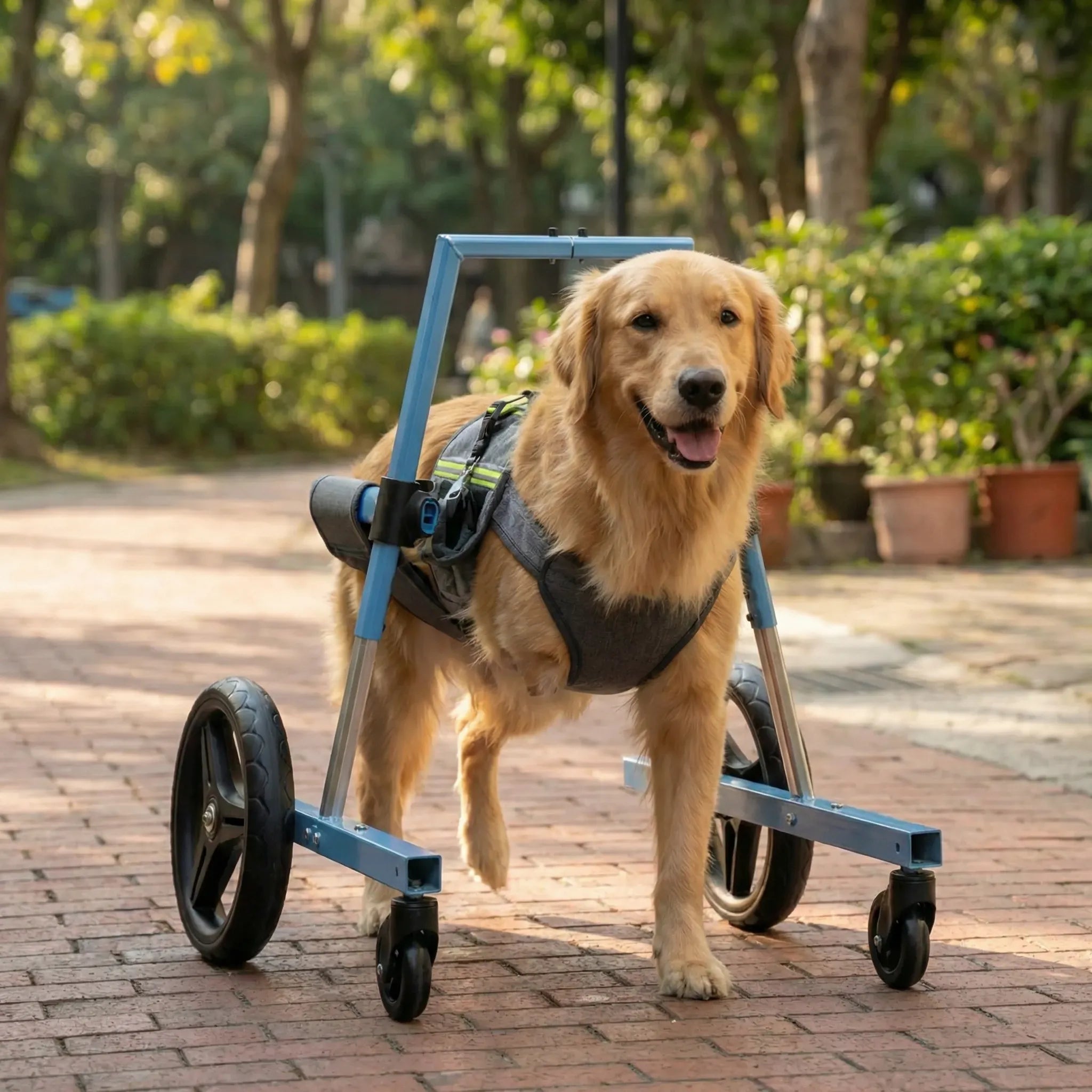
2-in-1 Support
Reconfigure the wheel position so the same cart can function as a dog wheelchair for front or rear legs.
| Size | Breed Examples (Reference) | Approx. Frame Weight |
|---|---|---|
| XS | Toy Poodle (Teddy), Shih Tzu, Bichon Frise | 1.2 kg (2.6 lbs) |
| S | Schnauzer, Shetland Sheepdog (Sheltie) | 1.3 kg (2.9 lbs) |
| M | Border Collie, Chow Chow | 3.2 kg (7.1 lbs) |
| L | Husky, Samoyed | 3.3 kg (7.3 lbs) |
| XL | Golden Retriever, Saint Bernard, Labrador Retriever | 3.4 kg (7.5 lbs) |
| XXL | German Shepherd, Alaskan Malamute | 3.5 kg (7.7 lbs) |
Note: Breed examples are for reference only. Dogs vary widely even within the same breed. For best fit, please measure your dog and contact us for size confirmation if you’re unsure.
Free standard shipping for most U.S. addresses. Remote areas/islands may require a surcharge, and we’ll confirm before shipment.
Processing time (Mon–Fri): 1–3 business days.
Delivery time after dispatch: Most orders arrive within 5–12 business days, depending on your destination, region, and local carrier.
If your address is affected, we’ll contact you before shipping to confirm the cost and provide options (alternative address or full refund if you prefer not to proceed).
Mobility needs can change. This universal dog wheelchair is designed to adapt with them. Configure the cart for front-leg support or rear-leg support by repositioning the wheel system, giving you a versatile 2 in 1 dog wheelchair for dogs that need targeted assistance without buying two separate mobility carts.
Important: This convertible dog wheelchair is designed for front OR rear support. It is not the same as a full-support cart designed to support the front and rear simultaneously.
Instead of locking your dog into one fixed support configuration, this adjustable universal dog wheelchair gives you greater flexibility for daily mobility, rehabilitation and age-related changes.
Reconfigure the wheel position so the same cart can function as a dog wheelchair for front or rear legs.
Hollow aviation aluminum and laser-welded construction provide everyday stability without creating an unnecessarily heavy cart.
Dual-bearing shock-absorbing tires are designed to reduce rolling resistance and provide smoother movement on common walking surfaces.
Padded contact areas and anti-chafe guards help reduce rubbing while adjustable components allow a closer fit to your dog's body.
Choosing the right mobility cart starts with understanding where your dog needs assistance. This model is especially useful when the support point may change over time.
The wheel position can be changed so the cart supports either the front end or the rear end.
Choose this convertible wheelchair for dogs when your dog needs targeted support and you value the flexibility to change configuration later.
Dogs that require simultaneous support at both ends may need a dedicated full-support mobility cart instead.
This distinction is especially important for dogs with severe balance problems or multi-limb weakness.
A mobility cart only works well when it is comfortable, stable and easy enough to adjust consistently.
Switch between front-leg and rear-leg support configurations based on your dog's current mobility needs.
Quick adjustment points make routine fitting and height changes easier.
Hollow aluminum construction keeps the mobility cart relatively light while maintaining the structure needed for regular use.
Designed to provide a stable frame and dependable connection points.
Shock-absorbing tires help create smoother rolling on sidewalks, patios and similar everyday surfaces.
Protective guards and padded straps are designed to reduce friction around sensitive contact areas.
Helps make getting your dog into and out of the mobility cart more convenient.
This dog mobility cart for front or rear legs may be suitable for dogs that still have useful strength in one end of the body but need added assistance at the other.
Older dogs can develop weakness, fatigue or reduced confidence as mobility changes. An adjustable cart can provide controlled support while allowing continued movement.
Configure the cart for front support when the front legs need assistance and the rear legs can still provide useful propulsion and balance.
Reconfigure it for rear support when the hind legs need assistance while the front legs remain strong enough to steer and move.
For some dogs recovering from injury or surgery, controlled mobility support may help make short, supervised walking sessions easier.
A 2-in-1 dog wheelchair may be useful when a dog's support needs change over time and a different configuration becomes more appropriate.
Best suited to dogs that need assistance primarily at one end rather than simultaneous full-body support.
Dogs of the same breed can differ significantly in height, length, weight and body shape. Breed names below should only be used as a starting reference.
| Size | Breed Examples | Approx. Frame Weight |
|---|---|---|
| XS | Toy Poodle, Shih Tzu, Bichon Frise | 2.6 lbs / 1.2 kg |
| S | Schnauzer, Shetland Sheepdog | 2.9 lbs / 1.3 kg |
| M | Border Collie, Chow Chow | 7.1 lbs / 3.2 kg |
| L | Husky, Samoyed | 7.3 lbs / 3.3 kg |
| XL | Golden Retriever, Saint Bernard, Labrador Retriever | 7.5 lbs / 3.4 kg |
| XXL | German Shepherd, Alaskan Malamute | 7.7 lbs / 3.5 kg |
The defining feature of this universal wheelchair for dogs is the ability to change the wheel arrangement instead of replacing the entire mobility cart.
Determine whether your dog currently needs support at the front or rear of the body.
Adjust the front and rear wheel positions for the selected configuration. Some setups may require loosening screws and swapping the left and right wheel brackets.
Adjust the height and strap tension so your dog stands naturally without excessive pressure, rubbing or an uneven body angle.
Before starting longer walks, use short supervised fitting sessions and watch how your dog stands and moves.
Your dog's body should remain reasonably level rather than tipping heavily forward or backward.
Straps should feel secure without digging into the armpits, groin, belly or other sensitive areas.
The cart should roll straight without consistently twisting or pulling to one side.
Start with short indoor sessions and allow your dog time to understand the new movement pattern before increasing duration.
Answers to the questions pet parents commonly ask when considering a convertible mobility cart.
Both configurations are possible. This is a universal dog wheelchair that can be configured for either front-leg support or rear-leg support by changing the wheel position.
This model is designed for front OR rear support. If your dog requires simultaneous stability at both ends, a dedicated full-support mobility cart may be more appropriate.
The wheel arrangement can be reconfigured so one cart can provide front-leg support or rear-leg support. That makes it a convertible dog wheelchair rather than a single-purpose fixed-support cart.
Reposition the front and rear wheels according to the required setup. Depending on the configuration, you may also need to loosen the screws and swap the left and right wheel brackets before readjusting the height and straps.
Yes. The cart includes push-button adjustment and adjustable height so you can fine-tune the setup for your dog's body and selected support configuration.
Measure your dog rather than choosing by breed alone. Breed examples are only references because dogs within the same breed can have very different body proportions. If you are unsure, send us your dog's breed, weight and measurements before ordering.
It can be used as a mobility aid for senior dogs that need targeted front or rear support. The correct configuration depends on which legs remain strong enough to provide propulsion and balance.
It may be useful for controlled mobility support during some rehabilitation situations. If your dog is recovering from surgery, has significant pain or has rapidly worsening weakness, follow your veterinarian or rehabilitation professional's guidance.
Every dog is different. Begin with short supervised indoor sessions of around 5–10 minutes, use positive reinforcement and gradually increase the duration as your dog becomes more confident.
The dual-bearing shock-absorbing tires are designed for common everyday walking surfaces such as sidewalks, patios and parks. Introduce new surfaces gradually and supervise your dog during use.
Choosing the right wheelchair starts with identifying where your dog needs support and getting accurate measurements. Use our fitting center first, or contact us with your dog's measurements if you want help confirming the setup.