

Dog mobility guide
If your dog is dragging his back legs, the safest first question is not “Is this old age?” It is “Did this happen suddenly, is my dog in pain, and can he still stand, walk, urinate, and pass stool normally?” Back-leg dragging can come from pain, joint weakness, nerve problems, spinal cord disease, injury, or a progressive mobility condition. Some causes are urgent and should not be watched at home.
Quick answer: what does back-leg dragging usually mean?
A dog dragging his back legs usually means the rear limbs are not moving normally because of one or more problems: poor nerve control, spinal cord compression, pain, weakness, loss of coordination, joint disease, or trauma. Sudden dragging, paralysis, severe pain, knuckling, loss of bladder or bowel control, or symptoms that worsen over minutes or hours should be treated as an emergency. Keep your dog still, prevent slipping, avoid forcing him to walk, and call a veterinarian or emergency clinic right away.
A dog wheelchair, rear lift harness, or drag protection can help many dogs after a veterinarian has identified the cause and confirmed that assisted movement is safe. Mobility gear should not be used as a substitute for urgent veterinary care when symptoms are sudden, painful, or worsening.

When back-leg dragging is an emergency
Do not wait overnight if your dog suddenly cannot use the back legs normally. Spinal cord and nerve problems can worsen quickly, and the timing of treatment can affect recovery.
- Your dog suddenly drags one or both back legs.
- Your dog cannot stand, cannot walk, or collapses repeatedly.
- The paws fold under, or your dog walks on the tops of the paws.
- Your dog cries, trembles, pants, guards the back, or refuses to move.
- Your dog loses bladder or bowel control, cannot urinate, or leaks urine.
- Weakness gets worse over minutes or hours.
- There was a fall, jump, car accident, rough play injury, or possible toxin exposure.
| What you see | Why it matters | Best next step | Helpful source |
|---|---|---|---|
| Sudden dragging, paralysis, severe back pain, or inability to walk | Can happen with serious spinal cord injury or intervertebral disc disease. | Emergency veterinary care now. Keep your dog still during transport. | ACVS: Intervertebral Disc Disease |
| Dragging plus loss of bladder or bowel control | May indicate advanced neurologic involvement or inability to empty the bladder. | Call an emergency clinic. Do not try to express the bladder unless trained by a vet. | Cornell: IVDD |
| Gradual scuffing, wobbling, or paw knuckling in an older dog | May fit progressive conditions such as degenerative myelopathy, but other treatable causes can look similar. | Schedule a veterinary exam soon and ask whether neurologic testing is needed. | University of Missouri CVM: DM |
| Back-leg dragging after a jump, fall, or accident | Trauma can injure the spine, pelvis, hips, knees, nerves, or soft tissues. | Limit movement and seek urgent veterinary advice before walking your dog. | Merck Veterinary Manual |
What to do in the first 10 minutes
When a dog starts dragging the back legs, the first few minutes should be about safety, not testing. Do not repeatedly make your dog walk to “see how bad it is.”
Safe first steps
- Move your dog to a quiet, non-slip area.
- Block stairs, sofas, beds, and slippery floors.
- Keep your dog still and calm while you call your veterinarian.
- Use a towel, blanket, or firm board to help transport a small or painful dog without twisting the back.
- Take a short video only if you can do it without making your dog walk more.
- Write down when the dragging started and whether it was sudden or gradual.
What not to do
- Do not give human pain medicine. Many human pain relievers are dangerous for dogs.
- Do not stretch, massage, or pull the back legs to “loosen them.”
- Do not use a wheelchair for sudden painful dragging before a vet checks for spinal injury.
- Do not let your dog climb stairs, jump, roughhouse, or walk on slick floors.
- Do not wait for a sudden paralysis case to “sleep it off.”
What the dragging pattern can tell you
Pet owners often describe several different problems as “dragging.” The pattern helps your veterinarian decide how urgent it is and where the problem may be coming from.
| Dragging pattern | What owners usually notice | Possible meaning | How urgent? |
|---|---|---|---|
| Both back legs suddenly drag | The rear body trails, dog cannot rise, or legs do not move normally. | Possible spinal cord, disc, nerve, trauma, or vascular event. | Emergency, especially if painful or worsening. |
| One back leg drags | One paw scuffs, turns under, or is carried awkwardly. | Could be nerve, spinal, hip, knee, muscle, or injury-related. | Urgent if sudden, painful, or after trauma. |
| Knuckling | The paw folds under, and the dog steps on the top of the foot. | Often suggests a proprioception or nerve-control problem. | Vet exam soon; emergency if sudden or severe. |
| Toe nails scrape over weeks or months | Worn nails, wobbly rear, swaying hips, difficulty rising. | Can happen with degenerative myelopathy, arthritis, hip disease, or other neurologic/orthopedic issues. | Schedule a veterinary exam; do not assume it is only aging. |
| Dragging only when tired | Dog starts normally, then rear legs weaken on longer walks. | Could involve pain, endurance loss, arthritis, neurologic disease, or poor conditioning. | Vet appointment recommended, especially if getting worse. |
Common causes of dog back-leg dragging
This table is not a diagnosis. It helps you match what you see at home with the kind of veterinary conversation you should have.
| Possible cause | Typical clues | Why back legs may drag | Helpful source |
|---|---|---|---|
| Intervertebral disc disease or disc injury | Back pain, arched back, reluctance to move, wobbling, knuckling, sudden weakness, paralysis, or incontinence. | A disc can press on the spinal cord or nerves, affecting rear-leg control. | Cornell: Intervertebral Disc Disease |
| Degenerative myelopathy | Older dog, gradual wobbling, paw knuckling, scuffed hind feet, difficulty rising, usually not painful in early stages. | A progressive spinal cord disease can reduce coordination and rear-limb strength. | VCA: Degenerative Myelopathy |
| Lumbosacral stenosis or lower-back nerve compression | Lower-back pain, difficulty using hind legs, tail weakness, trouble rising, possible urinary issues. | Compression near the lower back can affect nerves that control the rear limbs and tail. | Merck Veterinary Manual |
| Fibrocartilaginous embolism | Sudden weakness, often during activity; may be one-sided; not always painful after the first stage. | A spinal cord blood-flow event can cause sudden neurologic weakness or paralysis. | VCA: FCE in Dogs |
| Hip, knee, or arthritis pain | Slow rising, stiffness after rest, slipping, bunny-hopping, lameness, trouble with stairs. | Pain and joint instability can make the dog avoid normal rear-leg use. | Merck Veterinary Manual: Hip Dysplasia |
| Trauma or injury | Started after a fall, jump, accident, rough play, or sudden yelp. | Injury may affect the spine, pelvis, hips, knees, muscles, ligaments, or nerves. | ACVS: Spinal Injury Context |
| Whole-body illness, toxin exposure, or tick-related disease | Weakness plus vomiting, fever, pale gums, collapse, unusual breathing, or behavior change. | The problem may not be only the legs; the whole body may be weak or neurologically affected. | ASPCA Animal Poison Control |
Important difference: painful vs. not painful
A painful dog that is suddenly dragging the back legs should be handled as urgent. A dog with slowly progressive, non-painful wobbling still needs a veterinary exam because degenerative myelopathy, arthritis, hip disease, spinal tumors, disc disease, and other conditions can overlap in early signs. The safest plan is to identify the cause first, then choose the right support.
What information to give your vet
A clear history can save time. Before calling, write down the details below.
| Question | Why it helps | Your notes |
|---|---|---|
| When did the dragging start? | Sudden onset is more urgent than slow progression. | Exact time, date, or “over several weeks.” |
| Was there a fall, jump, slip, or accident? | Trauma changes the urgency and likely tests. | Sofa jump, stairs, car accident, rough play, slippery floor. |
| Is your dog painful? | Crying, trembling, panting, guarding, or refusing to move may suggest serious pain. | Describe what triggers pain. |
| Can your dog urinate and poop normally? | Bladder or bowel changes can be a serious neurologic warning sign. | Normal, leaking, unable to go, accidents, straining. |
| Which legs are affected? | One leg, both back legs, or all four legs can point to different locations. | Left rear, right rear, both rear, front legs too. |
| Can your dog still feel or place the paws normally? | Knuckling and poor paw placement are useful neurologic clues. | Do not pinch or test pain at home; just describe what you see. |
Safe home changes while waiting for care
Whether your dog is waiting for an appointment or recovering after a diagnosis, the goal is to reduce falls, skin damage, and overexertion.
| Home change | Why it helps | Best for |
|---|---|---|
| Add rugs, yoga mats, or non-slip runners | Reduces slipping and sudden twisting. | Dogs who scuff, wobble, or struggle to stand. |
| Block stairs and furniture | Prevents falls and jumping injuries. | Any dog with sudden or worsening mobility signs. |
| Use short, controlled potty breaks | Limits fatigue and risky movement. | Dogs under vet-directed rest or recovery. |
| Check paws and skin daily | Dragging can scrape nails, toes, and skin. | Dogs with knuckling, paw scuffing, or partial paralysis. |
| Keep bedding clean and dry | Helps reduce urine scald, odor, and pressure irritation. | Dogs with accidents, leakage, or limited movement. |
| Ask your vet about rehab | Controlled therapy may help strength, coordination, comfort, and confidence. | Stable dogs after diagnosis or surgery. |
For a broader mobility overview, see Dog-Wheelchair.com’s guide: Dog Back Legs Giving Out? Causes, Warning Signs & What to Do.
Mobility support product guide
Mobility gear is most useful after your dog has been checked by a veterinarian or when the condition is already known and stable. The right product depends on whether the issue is short assisted movement, rear-leg weakness, whole-body balance, or friction from dragging.
Before choosing a wheelchair
Do not put a dog with sudden painful dragging into a cart before a veterinary exam. A wheelchair can support movement, but it does not treat spinal compression, disc injury, infection, trauma, or pain. Once your vet confirms assisted walking is safe, a properly fitted cart can help reduce dragging, protect paws, and let your dog participate in short supervised activity.
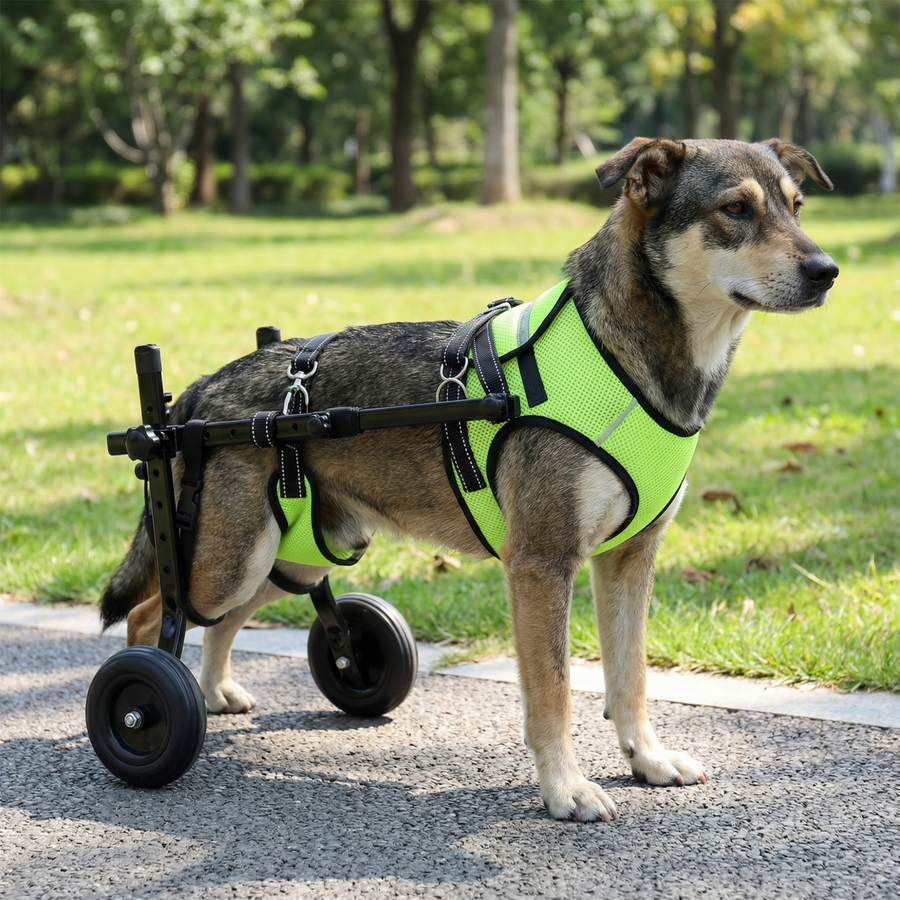
Adjustable Dog Wheelchair for Back Legs
Best for rear-leg weakness$149.99
Best for small dogs whose front legs are still strong enough to pull, steer, and move forward while the rear body needs support.
- Rear-leg dog wheelchair
- Adjustable front-back and height fit
- Breathable 3D mesh support
- Shock-absorbing rubber wheels
- Recommended pet weight: up to 22 lb
- Frame material: aluminum
- Item weight: 2.2 lb
- Warranty listed: 1 year
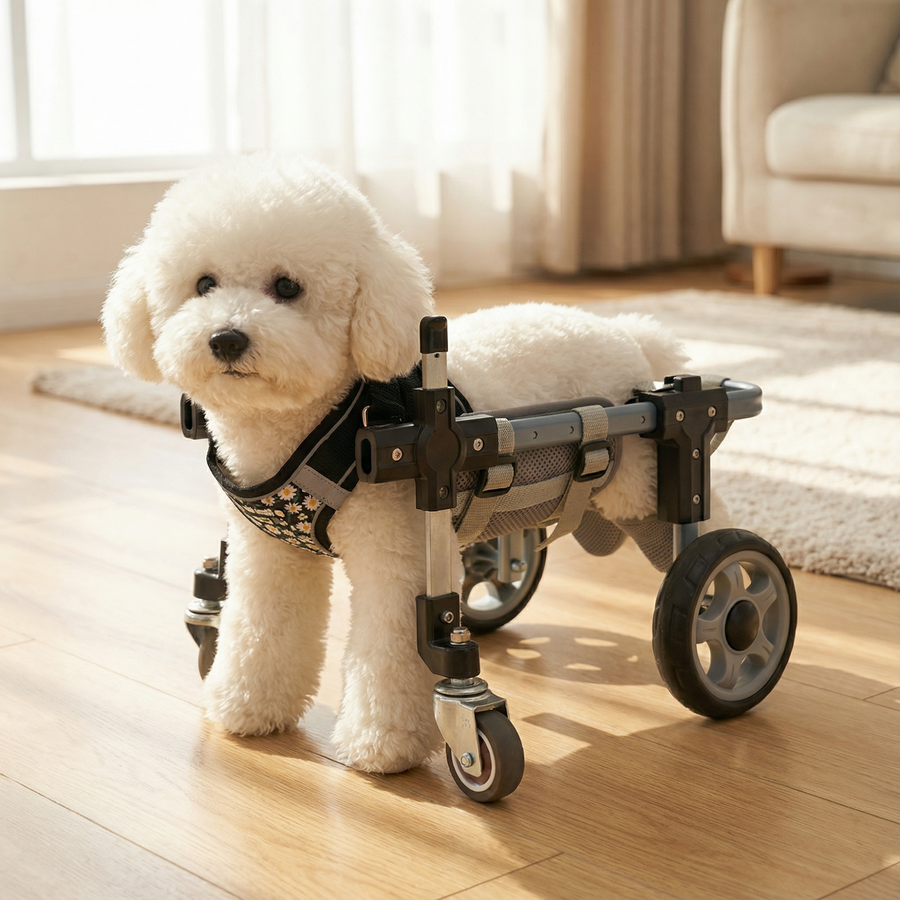
4-Wheel Dog Wheelchair, Full Support Cart for Front & Back Legs
Best for poor balance$187.99
Best for dogs who have weakness in both front and back legs, poor balance, tipping, or full-body instability where a standard rear cart is not enough.
- Full-body support with four wheels
- Front and rear harness system
- Sizes: XS, S, M, L
- Lightweight aluminum alloy frame
- Height, length, and width adjustable
- Bathroom-friendly open design
- Suitable for indoor floors, sidewalks, and short grass with supervision

Universal Dog Wheelchair for Front or Rear Legs
Best for changing support needs$299.99
Best when your dog’s support needs may change, or when you need one frame that can be configured for either front-leg or rear-leg support.
- 2-in-1 front-leg or rear-leg support mode
- Hollow aviation aluminum frame
- Laser-welded frame process
- Push-button adjustment
- Dual-bearing shock-absorbing tires
- Sizes: XS, S, M, L, XL, XXL
- Approx. frame weight range: 2.6–7.7 lb depending on size
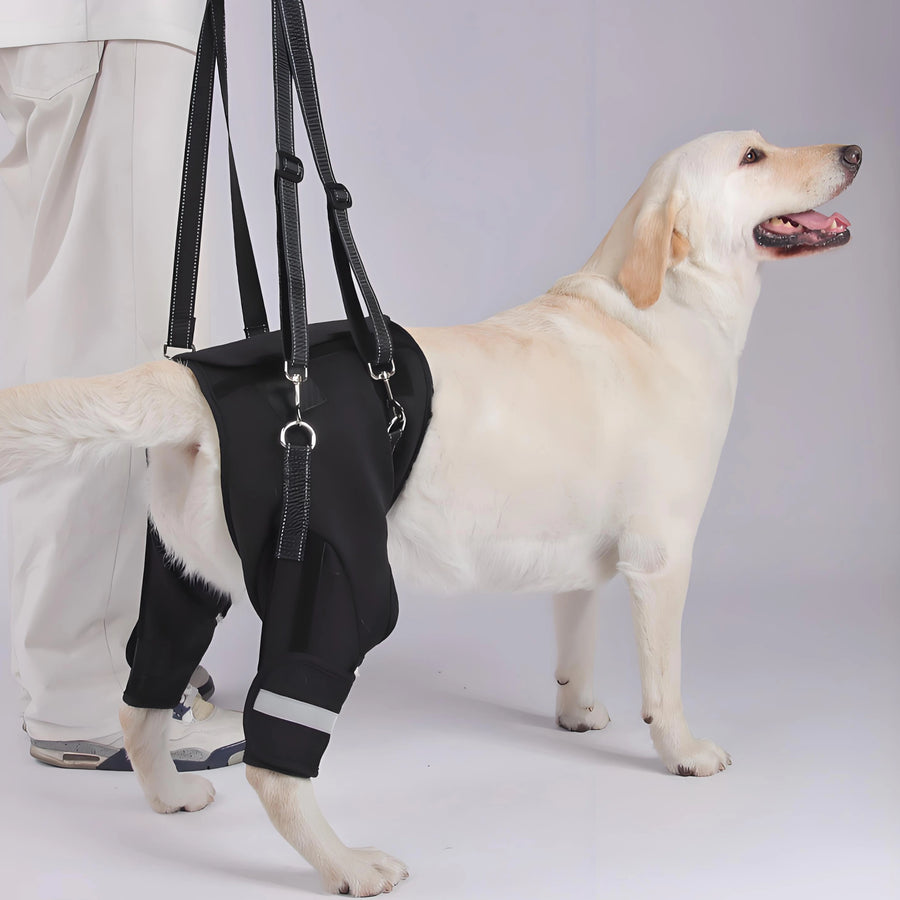
Dog Rear Lift Harness
Best for short assisted help$59.99
Best for dogs that can still participate in short movement but need help standing, using stairs, getting into a car, or taking short rehab-style walks.
- Rear support sling for weak hind legs
- Best for senior dogs, arthritis support, injury support, and post-surgery recovery
- Sizes: S, M, L, XL
- Materials: composite fabric, perforated neoprene, soft lining
- Hook-and-loop closure
- Recommended weight range listed by size: 16.5–99.2 lb
| Dog’s situation | Best starting support | Why | Product path |
|---|---|---|---|
| Back legs drag, but front legs are strong | Rear-leg 2-wheel wheelchair | Supports the rear body while the front legs drive movement. | Shop Back Leg Dog Wheelchairs |
| Back legs are weak only during stairs, potty breaks, or car entry | Rear lift harness | Gives hands-on support without committing to a cart. | View Rear Lift Harness |
| Both front and back legs are weak, or dog tips over | 4-wheel full-support cart | Supports both ends of the body and improves stability. | Shop 4-Wheel Carts |
| Support needs may change during recovery | Universal front/rear wheelchair | Can be configured for front-leg or rear-leg support. | View Universal Dog Wheelchair |
| Small pet drags the lower body on smooth floors for short sessions | Wheeled drag bag | Helps reduce friction and protect the lower body during supervised use. | View Dog Drag Bag |
How to choose the right support level
The biggest mistake is choosing a cart based only on the symptom name. A dog “dragging back legs” may need emergency care, a short-term rear lift harness, a rear wheelchair, a full-support cart, or no cart yet.
| Decision point | Choose this direction | Why it matters |
|---|---|---|
| Is the dragging sudden, painful, or worsening? | Vet first, no wheelchair yet. | Sudden spinal or neurologic problems should be evaluated before assisted walking. |
| Can the front legs pull strongly? | Rear-support wheelchair may fit. | Rear carts depend on front-leg strength for steering and forward movement. |
| Does your dog tip, cross legs, or lose balance at both ends? | Consider a 4-wheel cart after vet clearance. | Full-body support is safer than forcing a rear-only cart when balance is poor. |
| Does your dog only need help for stairs or standing? | Start with a rear lift harness. | A sling can support short transitions without overcomplicating daily care. |
| Are measurements between sizes? | Use the fit guide and contact support with measurements. | Chest girth, body length, height, and leg spacing affect comfort and rubbing risk. |
For sizing, use the Dog Wheelchair Fit & Sizing Center. It explains chest girth, body length, height, and leg-distance measurements so you can avoid common fit problems like rubbing, poor posture, and unstable balance.
FAQ
Why is my dog suddenly dragging his back legs?
Sudden back-leg dragging can be caused by spinal disc disease, spinal cord injury, trauma, nerve problems, vascular events, toxin exposure, or another urgent condition. Keep your dog still and call a veterinarian or emergency clinic right away, especially if there is pain, paralysis, knuckling, or loss of bladder or bowel control.
Can old age alone make a dog drag his back legs?
Age can increase the risk of arthritis, muscle loss, spinal disease, and degenerative conditions, but “old age” should not be treated as the diagnosis. A senior dog that drags the back legs still needs a veterinary exam to identify whether the cause is painful, progressive, treatable, or urgent.
Is back-leg dragging always painful?
No. Some dogs with degenerative myelopathy may have gradual, non-painful rear-leg weakness, while dogs with disc injury, arthritis, trauma, or lower-back nerve compression may be painful. Pain level is one of the most important clues, but it does not replace a veterinary exam.
Should I buy a dog wheelchair right away?
Not if the dragging is sudden, painful, or worsening. Get a veterinary diagnosis first. Once your vet confirms that supported movement is safe, a wheelchair may help if your dog still wants to walk but the back legs cannot work normally.
What type of wheelchair helps a dog dragging his back legs?
If the front legs are strong and only the rear legs need support, a rear-leg 2-wheel dog wheelchair is usually the best starting point. If the dog also has front-leg weakness, poor balance, or tips over, a 4-wheel full-support cart may be safer.
Can a harness help before a wheelchair?
Yes, a rear lift harness can help with short assisted movement such as standing, stairs, car entry, and potty breaks. It is not a replacement for veterinary care, and it may not be enough for dogs that cannot safely use the back legs for daily movement.
What should I avoid if my dog is dragging his back legs?
Avoid stairs, jumping, slick floors, rough play, forced walking, human pain medicines, and stretching or pulling the legs. If symptoms are sudden or painful, keep your dog still and seek urgent veterinary advice.
Can dogs still have a good quality of life with rear-leg weakness?
Many dogs can still enjoy daily life with the right veterinary plan, safe home setup, skin care, rehab guidance, and properly fitted mobility support. The best plan depends on the cause, pain level, bladder and bowel control, front-leg strength, and your dog’s comfort.
Need help choosing the right mobility support?
Measure your dog first, note whether the problem is rear-leg weakness, front-leg weakness, or full-body balance, and choose support only after urgent causes have been ruled out.
Use the Fit & Sizing Center · View Dog Wheelchairs · Shop Back-Leg Support
Sources used for medical accuracy and product details
This article is for owner education and does not replace a veterinary diagnosis. Medical background was checked against veterinary sources, and product details were checked against Dog-Wheelchair.com product pages at the time of writing.
- Merck Veterinary Manual: Disorders of the Spinal Column and Cord in Dogs
- Cornell Riney Canine Health Center: Intervertebral Disc Disease
- American College of Veterinary Surgeons: Intervertebral Disc Disease
- VCA Animal Hospitals: Degenerative Myelopathy in Dogs
- University of Missouri College of Veterinary Medicine: Degenerative Myelopathy
- Dog-Wheelchair.com: Adjustable Dog Wheelchair for Back Legs
- Dog-Wheelchair.com: 4-Wheel Dog Wheelchair
- Dog-Wheelchair.com: Universal Dog Wheelchair
- Dog-Wheelchair.com: Dog Rear Lift Harness
0 comments