

Quick Answer
Degenerative myelopathy, often shortened to DM, is a progressive spinal cord disease that usually begins with subtle rear-leg coordination problems and may eventually cause loss of hind-limb mobility. There is currently no cure, but a practical daily plan can help a dog remain active, protected and involved in family life for as long as possible.
In the early stage, focus on traction, short controlled walks, healthy body weight and veterinary rehabilitation. When rising, balance and paw placement become unreliable, add a rear-support harness and begin introducing a properly fitted wheelchair before every walk becomes a struggle. In later stages, mobility sessions become shorter and more assisted, while skin care, toileting, bedding, hygiene and quality-of-life monitoring become increasingly important.
DM is usually gradual and is not typically painful. Sudden weakness, severe pain, rapid paralysis, inability to urinate or a dramatic change over hours should not be assumed to be DM. Those signs require prompt veterinary care.
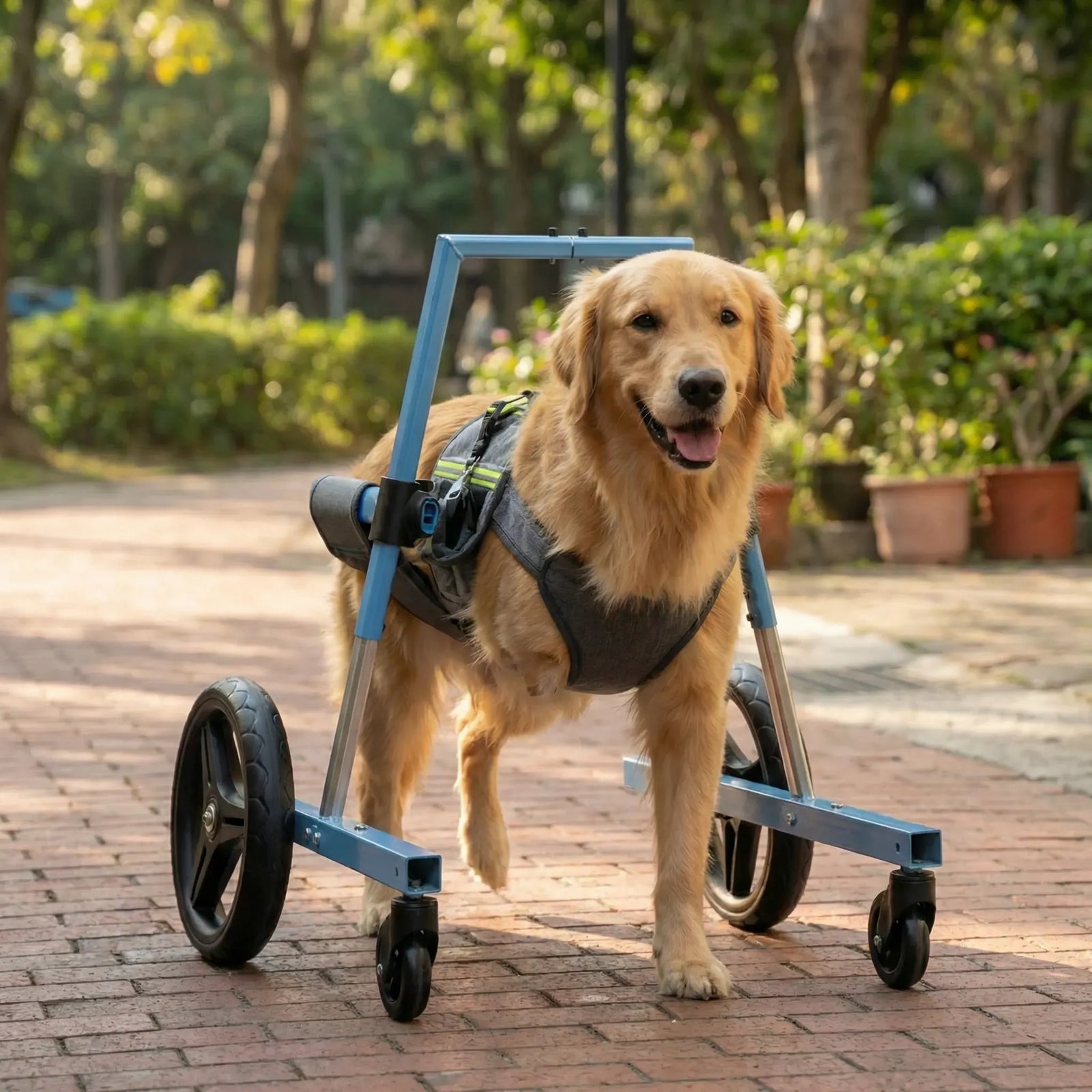
What Is Degenerative Myelopathy in Dogs?
Degenerative myelopathy is a progressive neurologic disease that damages the spinal cord. It most often begins in older dogs and first affects communication between the spinal cord and the hind limbs. Owners may notice swaying, scuffed toenails, paw knuckling, crossed rear legs, delayed paw placement or increasing difficulty standing.
As the disease progresses, the dog loses more coordination and strength. The rear legs may eventually become unable to support the body. In advanced cases, weakness can extend toward the front of the body.
According to the Cornell University College of Veterinary Medicine, many affected dogs are eight years old or older. Cornell notes that loss of independent walking commonly develops over approximately six to twelve months, but the course is not identical in every dog.
DM is often associated with variants of the SOD1 gene. However, a genetic result shows risk; it does not prove that a dog’s current weakness is caused by DM. Some dogs with risk variants never develop clinical disease, while other spinal, orthopedic and neurologic disorders can create similar symptoms.
DM is not simply “old age”
Normal aging may slow a dog down, but repeated paw knuckling, dragging, falling, crossing the rear legs or losing the ability to rise deserves a veterinary examination. A diagnosis of DM generally requires the veterinarian to rule out other possible causes of hind-leg weakness.
Before Using a Stage-Based Care Plan
There is no single universally adopted four-stage system used by every veterinary neurologist. The stages below are a practical home-care framework based on what the dog can still do independently. They are meant to help families adjust flooring, exercise, support equipment and nursing care—not to replace a veterinary neurologic examination.
Do not assume sudden weakness is DM
| Pattern | More consistent with gradual DM | Reason to seek urgent care |
|---|---|---|
| Speed of change | Changes develop gradually over weeks or months. | Weakness or paralysis appears over minutes or hours. |
| Pain | DM itself is generally considered nonpainful. | Crying, shaking, a tense back, reluctance to move or severe tenderness. |
| Walking | Progressive wobbling, scuffing, crossing or knuckling. | Sudden collapse, complete inability to stand or rapid worsening. |
| Urination | Control may be normal early and become more difficult later. | Straining without producing urine, a painful abdomen or sudden loss of control. |
| Recent event | No clear injury; progression is gradual. | Recent fall, jump, collision, rough play, toxin exposure or possible tick illness. |
For more detailed emergency warning signs, read Why Is My Dog Dragging His Back Legs? and Dog Back Legs Giving Out: Causes, Warning Signs and What to Do.
What a veterinarian may need to rule out
Conditions that can resemble DM include intervertebral disc disease, spinal tumors, lumbosacral disease, orthopedic pain, hip disease, cruciate injury, infection, inflammation and other neurologic disorders. Imaging, blood testing, a neurologic examination and other tests may be recommended depending on the dog’s history and signs.
The Orthopedic Foundation for Animals provides SOD1 testing information, but genetic testing should be interpreted together with the dog’s examination and other diagnostic findings.
Degenerative Myelopathy Mobility Stages at a Glance
| Functional stage | What the dog can usually do | Common daily problems | Primary support goal | Helpful equipment |
|---|---|---|---|---|
| Stage 1: Independent but uncoordinated | Walks without being held up but may sway, scuff or misplace a rear paw. | Slipping, worn nails, fatigue, delayed rising and occasional falls. | Preserve safe movement and prevent avoidable injury. | Traction runners, toe protection, ramps and a standard harness. |
| Stage 2: Assisted walking | Can still step but needs help rising, turning, toileting or completing walks. | Frequent falls, crossed legs, dragging, difficulty squatting and rapid fatigue. | Reduce falls while keeping the dog participating in movement. | Rear lift harness, support sling and gradual wheelchair introduction. |
| Stage 3: Cart-assisted or nonambulatory rear limbs | Front legs remain useful, but the rear legs cannot safely support walking. | Rear paw trauma, inability to rise, toileting instability and muscle loss. | Provide supported exercise and protect skin, joints and dignity. | Rear-support wheelchair, padded bedding, paw protection and hygiene supplies. |
| Stage 4: Advanced support needs | Mobility is severely limited and front-limb or whole-body weakness may appear. | Positioning difficulty, pressure injury risk, hygiene needs and reduced endurance. | Prioritize comfort, connection, clean skin and realistic quality-of-life goals. | Full-body assistance planned with the veterinary team, supportive bedding and nursing supplies. |
A dog may show features from two stages at the same time. Base daily decisions on what the dog can safely do today rather than on the date of diagnosis.
Independent but Uncoordinated
What you may notice
- The rear end sways when walking or turning.
- One rear paw occasionally folds under.
- Rear toenails scrape against pavement.
- The dog crosses the rear legs or takes unusually narrow steps.
- Standing up takes longer, especially on smooth floors.
- The dog tires sooner but can still complete normal household activities.
- Small falls occur when turning quickly or stepping over thresholds.
Daily mobility priorities
1. Create a traction route through the home
Do not cover every inch of the house at once. First create a continuous nonslip route between the dog’s bed, water bowl, feeding area, favorite family room and outdoor potty door. Use secured runners, low-pile rugs or yoga mats that do not bunch under the feet.
Rugs placed as isolated “islands” are less useful because the dog may still need to cross exposed hardwood or tile between them.
2. Replace one long walk with several shorter walks
A dog with early DM may look reasonably coordinated at the beginning of a walk and become much less stable after fatigue sets in. Two or three controlled outings are often more useful than one exhausting trip.
End the walk while the dog is still moving with reasonable control. Do not use stumbling at the end of a walk as proof that the dog received enough exercise.
3. Watch the rear nails and tops of the paws
Check both rear feet after outdoor activity. Early dragging may first appear as uneven nail wear, a shortened nail, missing hair or redness on the top surface of one paw.
Protective boots may reduce scraping injuries, but they should fit securely without restricting circulation. Remove them after activity and inspect the skin. A boot that twists can create a different rubbing problem.
4. Ask for a rehabilitation baseline
A veterinarian or credentialed canine rehabilitation professional can document the dog’s current strength, range of motion, balance and endurance. This gives you a safer starting point than copying a generic exercise routine.
Physical rehabilitation cannot cure DM, but veterinary sources including VCA Animal Hospitals and Cornell University recommend maintaining activity and using physical therapy to help preserve function and muscle mass.
5. Keep body weight controlled
Extra weight makes every rise, turn and supported step harder. Ask your veterinarian to set a target body condition and daily calorie plan rather than making a drastic food reduction without guidance.
A practical Stage 1 routine
Morning: A short traction-controlled walk, paw inspection and breakfast on a nonslip surface.
Midday: A brief potty trip plus veterinarian-approved balance or weight-shifting work.
Evening: A second controlled walk, gentle grooming and a quick nail and skin check.
Once weekly: Record a short video of the dog walking away from the camera, toward the camera and turning in both directions on the same surface.
Move to Stage 2 support when:
- The dog regularly needs help getting up.
- Falls occur during most walks.
- Rear paws drag long enough to damage skin or nails.
- The dog stops attempting normal movement because slipping has become frightening.
- Squatting to urinate or defecate is no longer stable.
Walking With Assistance
What you may notice
- The dog can step but cannot consistently support the rear body.
- Standing requires several attempts or help from a person.
- The hips drop when turning.
- The rear legs cross, buckle or drag more frequently.
- Short walks become tiring even though the dog still wants to explore.
- The dog struggles to remain upright while urinating or defecating.
- Front legs remain strong enough to bear weight and pull forward.
Daily mobility priorities
1. Support the pelvis without lifting the whole dog off the floor
A rear-support harness should steady the hips while allowing the rear paws to participate when the dog can still place them. Constantly carrying the rear end too high may prevent useful stepping and create an unnatural posture.
Adjust your lift according to the task. More support may be needed for rising or crossing a threshold; less support may be appropriate during several controlled steps on level ground.
2. Use support before the fall, not only after it
Families often wait until the dog is already collapsing before reaching for the harness. Place the support before getting out of bed, approaching stairs, entering the yard or beginning a potty squat.
3. Begin wheelchair training before complete paralysis
A wheelchair does not have to be reserved for the day a dog can no longer move. Introducing it while the dog still has confidence, front-leg strength and interest in walking can make the transition less stressful.
Start indoors on a level, nonslip surface. Use a few treats or a familiar person several feet ahead. The first goal is not distance—it is a calm, positive experience in which the dog learns that moving the front legs makes the cart roll.
4. Separate “exercise support” from “transfer support”
A rear lift harness is often convenient for getting out of bed, reaching the yard, entering a vehicle or maintaining a potty position. A properly fitted wheelchair is often more practical for a supervised walk because it supports the rear body without requiring the caregiver to bend over for the entire outing.
5. Reduce environmental difficulty
- Block unsupervised stair access.
- Replace jumping into the car with a stable ramp or assisted transfer.
- Keep food and water on the same accessible level.
- Widen paths between furniture for harness and wheelchair clearance.
- Avoid steep hills, loose gravel, deep sand and slippery wet surfaces.
A practical Stage 2 routine
Morning: Harness-assisted rise, supported potty trip, paw inspection and a short controlled walk.
Midday: Rest, gentle position changes and a brief veterinarian-approved mobility session.
Late afternoon: Five to ten minutes of introductory wheelchair work if the dog remains comfortable and attentive.
Evening: Assisted potty break, harness contact-point check and quiet enrichment near the family.
Signs the current support is no longer enough
- The caregiver must carry nearly all rear-body weight during every step.
- The dog repeatedly falls despite harness assistance.
- Rear paw injuries continue even with shorter walks and protection.
- The dog can no longer complete a short outing without severe fatigue.
- The front legs are doing all forward movement while the rear legs provide little useful support.
Mobility Products for Changing DM Support Needs
Mobility equipment should match the dog’s current weakness pattern. A wheelchair is an assistive tool, not a treatment for the spinal cord disease, and it should not be used to delay an examination when symptoms are sudden, painful or rapidly worsening.
Before ordering a cart, measure the dog rather than relying only on weight or breed. Use the Dog Wheelchair Fit & Sizing Center or follow the step-by-step wheelchair measuring guide.

Dog Rear Lift Harness
Best suited to dogs that can still take steps but need help rising, using stairs, entering a vehicle, maintaining balance during a potty break or walking a short distance.
- Designed for senior, injured or disabled dogs with weak back legs.
- Breathable neoprene support with a padded lifting handle.
- Available in sizes S through XL.
- Published recommended weight range spans approximately 16.5 to 99.2 pounds, depending on waist measurement.
- Most useful for short assisted tasks rather than replacing a wheelchair during longer walks.
| Size | Waist | Published weight guide |
|---|---|---|
| S | 13.0–16.9 in | 16.5–27.6 lb |
| M | 15.7–20.9 in | 27.6–44.1 lb |
| L | 19.7–27.6 in | 44.1–66.1 lb |
| XL | 25.6–33.5 in | 66.1–99.2 lb |

Universal Dog Wheelchair for Front or Rear Legs
For DM, this cart may be configured for rear-leg support while the dog still has enough front-leg strength to propel and steer the wheelchair. It offers a broader published size range than the small-dog carts and includes reference sizes through large breeds.
- Can be configured for front-leg or rear-leg support by changing the wheel position.
- Available in XS through XXL.
- Published breed references range from toy breeds to German Shepherds, Labradors, Golden Retrievers and Alaskan Malamutes.
- Hollow aviation-aluminum frame with push-button adjustment.
- Published approximate frame weights range from 2.6 to 7.7 pounds, depending on size.
- Dual-bearing shock-absorbing tires and padded anti-chafe contact areas.
Breed examples are only a starting reference. Dogs of the same breed can have very different body lengths, heights and chest dimensions. Confirm measurements before choosing a size.

Adjustable 2-Wheel Wheelchairs for Small and Medium Dogs
These rear-support carts are designed for dogs whose primary weakness is in the back legs and whose front legs remain strong enough to walk, steer and pull the cart.
- The small adjustable rear-leg wheelchair is published for small dogs up to 22 pounds.
- The medium rear-leg wheelchair is published for dogs up to 33 pounds.
- Both use an adjustable frame and supportive body harness.
- The medium version includes shock-absorbing wheels and a reinforced lightweight frame.
- These products are not suitable when the front legs cannot support or propel the dog.
Wheelchair-Assisted or Nonambulatory Rear Limbs
What you may notice
- The dog cannot stand or walk safely without substantial rear support.
- The back legs drag rather than taking useful steps.
- The front legs remain capable of supporting and moving the body.
- The dog may still be bright, engaged and eager to go outside.
- Muscle loss over the hips and thighs becomes more visible.
- Turning in bed or changing position becomes difficult.
- Bathroom posture may require hands-on support.
Daily mobility priorities
1. Use the wheelchair for purposeful movement, not all-day wear
A mobility cart is useful for supervised exercise, outdoor exploration and some potty routines. It is not a replacement for a bed, and the dog should not be left unattended in the cart.
Remove the cart for sleep, long rest periods and any situation in which the dog becomes tired, distressed or unable to maintain a comfortable front-body posture.
2. Start every session with a fit and skin check
- Confirm that straps are flat rather than twisted.
- Make sure the chest is not pulled backward by the frame.
- Check that the cart remains centered instead of pulling to one side.
- Keep pressure away from the armpits, groin and belly midline.
- Confirm that the rear paws are either safely placed or fully protected from dragging.
- Look for redness, warmth, dampness or hair loss after the session.
3. Let the dog set the pace
Front legs perform more work in a rear-support wheelchair. A dog that once walked for thirty minutes may now do better with several five- to ten-minute sessions. Stop before the front legs become exhausted.
4. Protect joints through positioning
When resting, place the dog on supportive, dry bedding with enough room to extend the limbs naturally. Help the dog change sides at intervals recommended by the veterinary team, especially if the dog cannot reposition independently.
5. Continue only veterinarian-approved range-of-motion work
Passive range-of-motion exercises may help maintain joint flexibility, but incorrect force, direction or repetition can cause discomfort or injury. Ask a rehabilitation professional to demonstrate the exact technique on your dog.
6. Keep the dog socially involved
Loss of walking does not automatically mean loss of interest in life. Move the dog’s resting area near normal family activity. Offer sniffing, food puzzles, grooming, outdoor air, calm car rides when safe and regular interaction.
A practical Stage 3 routine
Morning: Skin and bedding check, assisted transfer, supported potty opportunity and a short wheelchair outing.
Midday: Rest outside the cart, position change, gentle grooming and veterinarian-approved limb care.
Afternoon: A second short mobility session focused on sniffing and engagement rather than distance.
Evening: Supported potty trip, cleaning and drying of the rear body, bedding reset and quality-of-life notes.
Stop the wheelchair session when:
- The dog pants more than expected for the temperature and activity.
- The front feet begin to stumble or scuff.
- The dog repeatedly stops, freezes or attempts to sit.
- The cart pulls sideways or a strap shifts into a sensitive area.
- The dog appears anxious, distressed or unusually fatigued.
- Skin becomes red, warm or rubbed.
Advanced Nursing and Full Support
What you may notice
- Severe loss of rear-limb function.
- Increasing weakness in the front limbs or whole body.
- Reduced ability to hold the chest upright.
- Difficulty repositioning without help.
- Greater need for urinary, bowel and hygiene assistance.
- Shorter periods of useful activity.
- Higher risk of pressure irritation, damp skin and secondary infection.
Daily priorities change from distance to comfort
At this stage, success is no longer measured by how far the dog walks. The practical goals are comfortable breathing, clean and dry skin, supported rest, safe elimination, appetite, hydration, social connection and manageable caregiving.
1. Reassess whether the current cart remains appropriate
A rear-support wheelchair depends on usable front-leg strength. If the dog cannot hold the front body upright, repeatedly collapses in the cart or cannot propel safely, stop using that setup and ask the veterinarian or rehabilitation professional to reassess support options.
Do not continue a rear cart simply because the dog used it successfully earlier in the disease.
2. Build a bedding system, not just a bed
Use supportive padding with washable, moisture-managing layers. Keep several clean covers ready so damp bedding can be changed immediately instead of waiting for laundry.
Check shoulders, hips, hocks, elbows, ankles and other bony contact points. Persistent redness, open skin, swelling, odor or discharge should be reported to the veterinarian.
3. Keep food and water accessible without unsafe positioning
The dog should be supported in a comfortable upright position for eating and drinking. Coughing, gagging, difficulty swallowing or a sudden change in breathing requires veterinary advice.
4. Ask for hands-on nursing instruction
The veterinary team can demonstrate safe transfers, positioning, cleaning, diaper use when appropriate and urinary monitoring. Do not attempt bladder expression unless a veterinary professional has confirmed that it is needed and shown you the correct method.
5. Keep a written quality-of-life record
Memory becomes unreliable during a slow decline. A written record helps the family and veterinarian see whether comfortable, engaged days still outnumber difficult days.
Contact a veterinarian promptly for:
- New pain, crying, trembling or resistance to being touched.
- Labored breathing, persistent coughing or swallowing difficulty.
- Inability to urinate, repeated straining or a painful abdomen.
- Blood in the urine, foul-smelling urine or fever-like illness.
- Open wounds, pressure sores or rapidly worsening skin damage.
- Repeated vomiting, refusal of food or inability to stay hydrated.
- A sudden neurologic decline rather than the dog’s usual gradual pattern.
A Realistic Daily Care Schedule for a Dog With DM
The best routine is repeatable. A complicated plan that exhausts the dog or caregiver will not be sustainable. Use the schedule below as a framework and adjust it with your veterinarian.
| Time | Mobility task | Health check | Stage adjustments |
|---|---|---|---|
| On waking | Assist rising before the dog struggles or slips. | Check bedding, urine, stool, skin and overnight comfort. | Stage 1 may need traction only; Stages 2–4 may need a harness or full transfer assistance. |
| First potty trip | Use the least support that keeps the dog stable. | Note urine amount, straining, accidents and stool quality. | Use a harness for balance or a wheelchair only when the dog can toilet comfortably in it. |
| Morning movement | Short controlled walk or cart session. | Watch paw placement, falls, fatigue and front-leg effort. | Reduce time as coordination declines; preserve interest rather than chasing distance. |
| After activity | Remove support equipment and allow rest. | Inspect paws, nails, armpits, groin, chest and strap contact points. | Clean and dry any damp or irritated area immediately. |
| Midday | Brief potty trip and veterinarian-approved home exercises. | Check appetite, hydration and ability to reposition. | Advanced dogs may need position changes and bedding checks instead of active exercise. |
| Late afternoon | Second short mobility or enrichment session. | Compare coordination with the morning session. | A large afternoon decline may mean the morning session was too demanding. |
| Before bed | Final supported potty opportunity and comfortable transfer. | Clean the rear body, dry the coat and check pressure points. | Set up fresh bedding and keep needed lifting equipment within reach. |
Use a “mobility budget”
Think of the dog as having a limited daily supply of coordinated movement. Necessary tasks—getting up, toileting, eating and reaching the family—use part of that supply. Rehabilitation and enjoyable walks use another part.
Do not spend the entire budget on one ambitious morning walk and leave the dog unable to complete essential tasks later. Preserve enough energy for safe evening toileting and comfortable transfers.
How Much Exercise Is Appropriate for a Dog With DM?
Exercise should preserve participation without producing prolonged fatigue or repeated falls. There is no universal number of minutes that is correct for every dog.
A frequently cited 2006 study published in the Journal of Veterinary Internal Medicine followed a small group of dogs with suspected DM. Dogs receiving intensive controlled physiotherapy had a longer mean survival time than dogs receiving moderate or no physiotherapy.
The result supports rehabilitation as an important management tool, but it should not be interpreted as a guarantee. The study was small, was not randomized and included limitations in definitive diagnosis. A personalized rehabilitation plan remains safer than copying the most intensive routine possible.
The traffic-light exercise rule
Green: Continue at the current level
- The dog remains interested and moves willingly.
- Gait stays reasonably similar from the beginning to the end.
- Breathing settles normally after activity.
- The dog can still rise and toilet later in the day.
- No new paw, nail or harness irritation appears.
Yellow: Shorten or modify the next session
- Toe dragging becomes noticeably worse near the end.
- The rear legs cross more frequently.
- The dog needs substantially more help after exercise.
- The dog sleeps unusually deeply or avoids the next outing.
- Front legs appear overworked after wheelchair use.
Red: Stop and contact the veterinary team
- New pain, crying or guarding occurs.
- Weakness changes suddenly rather than gradually.
- The dog collapses and cannot recover with normal assistance.
- Breathing becomes labored or abnormal.
- The dog cannot urinate or develops other urgent symptoms.
Exercise options to discuss with a rehabilitation professional
- Controlled leash walking on a high-traction surface.
- Weight shifting while safely supported.
- Carefully selected sit-to-stand work in dogs that can perform it without collapsing.
- Underwater treadmill sessions with professional supervision.
- Swimming only when entry, exit, flotation, temperature and fatigue can be controlled.
- Passive range-of-motion work in dogs that can no longer move a joint through its normal range independently.
More exercise is not automatically better. Repeated stumbling, forced walking and exercise to exhaustion can increase falls, paw trauma and caregiver strain without restoring damaged spinal cord function.
When Should a Dog With DM Start Using a Wheelchair?
Consider discussing a wheelchair when hind-leg weakness begins limiting safe, enjoyable movement—not only after the dog becomes completely unable to walk.
Signs a wheelchair evaluation is reasonable
- The dog still wants to walk but repeatedly falls or drags the rear paws.
- A caregiver must hold most of the rear-body weight throughout walks.
- A rear harness works for transfers but is physically difficult during longer outings.
- Front legs remain strong and coordinated enough to propel a rear-support cart.
- The dog is alert, engaged and motivated to explore.
- Rear paw injuries recur despite shorter outings and protective measures.
A wheelchair readiness check
| Question | Why it matters |
|---|---|
| Can the dog bear weight on the front legs? | A rear cart requires the front limbs to support, propel and steer the body. |
| Does the dog still show interest in movement? | A wheelchair works best when it supports an activity the dog still wants to perform. |
| Can equipment contact the skin safely? | Open wounds, infection or severe irritation may need treatment before cart use. |
| Can the home accommodate the frame? | Narrow doorways, clutter, stairs and tight furniture arrangements may need modification. |
| Has the dog been measured? | Correct chest, body, height and leg-spacing measurements reduce rubbing and instability. |
| Can the caregiver supervise every session? | A dog should not be left unattended in a mobility cart. |
How to introduce the wheelchair
- Assemble and adjust the cart before bringing the dog into the fitting area.
- Choose a quiet, nonslip indoor space.
- Let the dog inspect the equipment without being placed in it immediately.
- Complete a brief fitting and check that straps are flat and comfortable.
- Encourage one or two forward steps with treats or a familiar person.
- End the first session while the dog is calm.
- Check every contact point after removing the cart.
- Increase time gradually according to comfort and front-leg endurance.
For fit details, use the Fit & Sizing Center. The cart should remain centered, roll straight and support the dog without forcing the hips or shoulders into an unnatural position.
Paw, Skin and Hygiene Care
In many DM dogs, a small paw injury is the first visible consequence of lost coordination. Later, immobility, harness contact and urine exposure create additional skin risks.
Rear paw inspection
Check the following after every outdoor mobility session:
- Uneven or shortened nails.
- Blood at the nail edge.
- Hair loss on the top of the toes.
- Redness, heat or swelling.
- Cracks in the paw pads.
- Moisture trapped inside boots.
- A boot that rotates or rubs the dewclaw area.
Harness and wheelchair contact points
Check the armpits, chest, belly, groin, inner thighs and any area touching a strap or saddle. Redness that remains after the equipment is removed may indicate excess pressure, friction, dampness or poor alignment.
Pressure-area checks in nonambulatory dogs
Pay special attention to hips, shoulders, elbows, hocks and ankles. Bedding should remain clean, dry and supportive. Help a dog that cannot turn independently change position at a schedule recommended by the veterinary team.
Keep the coat dry
Urine and stool left against the skin can cause irritation and infection. Clean soiled hair promptly, rinse or wipe according to veterinary advice and dry the area completely before placing the dog back on bedding.
Avoid applying human diaper creams or medicated products unless a veterinarian confirms that the ingredients are safe for the dog, especially when the dog may lick the area.
Potty Support and Urinary Monitoring
Many dogs maintain bladder and bowel control during the earlier part of DM. As mobility declines, accidents may occur because the dog cannot rise or maintain a squat even when neurologic control is still partly present. Later disease can also affect elimination more directly.
Make potty trips predictable
- Offer trips at regular times rather than waiting for the dog to signal and then struggle to reach the door.
- Use the harness before the dog attempts to stand.
- Choose a level, high-traction potty surface.
- Allow enough time for positioning without forcing the rear legs.
- Use the same route to reduce turning and obstacles.
- Record urine volume, frequency, odor, color and straining.
Watch for urinary infection
The PDSA degenerative myelopathy guide notes that urinary incontinence can increase the risk of urinary infection. Contact the veterinarian if you notice blood, strong odor, cloudy urine, frequent small amounts, straining, fever-like illness or a sudden increase in accidents.
Do not guess about bladder expression
A dog that leaks urine may still have an overly full bladder. Conversely, unnecessary or incorrect manual expression may cause injury. A veterinarian should determine whether expression is needed and demonstrate the technique in person.
Wheelchair potty use
Many rear-support carts are designed with an open rear area, allowing some dogs to urinate or defecate while supported. Success depends on the individual dog’s posture, fit and neurologic function.
Do not insist that the dog toilet in the cart if the position is uncomfortable. Some dogs do better with a rear lift harness for bathroom trips and the wheelchair for exercise.
A Weekly DM Mobility Tracker
Daily changes may be too subtle to notice. Track the same functions each week so you can identify a real trend rather than relying on one unusually good or bad day.
| Function to track | What to record | Why it matters |
|---|---|---|
| Rising | Independent, several attempts, harness help or full lift. | Shows changing transfer needs. |
| Falls | Number per day and the activity that caused them. | Helps identify unsafe surfaces and progression. |
| Paw placement | Scuffing, knuckling, crossing and which side is worse. | Documents coordination changes and injury risk. |
| Walking endurance | Minutes before gait noticeably worsens. | Helps set a safe activity limit. |
| Wheelchair endurance | Comfortable minutes before front-leg fatigue. | Prevents overworking the front limbs. |
| Skin | Redness, rubbing, dampness, wounds or pressure areas. | Detects complications before they become severe. |
| Urination | Frequency, accidents, odor, color and straining. | Helps identify infection or retention concerns. |
| Stool | Frequency, consistency and ability to posture. | Shows toileting and digestive changes. |
| Comfort | Restlessness, panting, crying, sleep and response to touch. | Pain is not typical of DM and may indicate another problem. |
| Engagement | Interest in food, family, sniffing, play and outdoor time. | Provides a more complete quality-of-life picture than walking alone. |
Use consistent videos
Once a week, record the dog on the same surface and from the same angles:
- Walking away from the camera.
- Walking toward the camera.
- Walking from the side.
- Turning left and right.
- Rising from the normal bed.
- Using the harness or wheelchair.
Short, consistent videos are often more useful to the veterinary team than a long video recorded only after a major decline.
Quality of Life: Look Beyond Walking
A dog can lose independent mobility and still enjoy food, family contact, outdoor smells, grooming and familiar routines. At the same time, mobility equipment should not be used to ignore worsening discomfort, fear, infection, respiratory difficulty or unmanageable nursing needs.
Use three practical questions
1. Is the dog comfortable?
Look at breathing, sleep, skin, elimination, appetite, restlessness and response to handling. Because DM itself is generally nonpainful, new pain deserves investigation rather than being accepted as inevitable progression.
2. Does the dog still have agency?
Can the dog choose to sniff, eat, rest near the family, go outdoors or engage with favorite activities using appropriate support?
3. Is meaningful connection still present?
Does the dog seek attention, respond to familiar people, enjoy food or show interest in the environment?
Read Are Disabled Dogs Happy? Signs of a Good Quality of Life for a broader seven-day quality-of-life approach.
Discuss end-of-life decisions before a crisis
Ask the veterinarian which changes should trigger an urgent call and which quality-of-life thresholds your family considers unacceptable. Planning does not mean giving up. It prevents the family from being forced to make every decision during an emergency.
Possible discussion points include:
- Uncontrolled pain or distress.
- Persistent breathing or swallowing difficulty.
- Repeated infections or wounds that cannot be kept comfortable.
- Loss of appetite and hydration.
- Inability to rest comfortably.
- Loss of interest in nearly all valued activities.
- Nursing demands that cannot be met safely despite available help.
- Difficult days consistently outnumbering comfortable, engaged days.
Frequently Asked Questions
Is degenerative myelopathy painful for dogs?
DM itself is generally considered nonpainful. A dog may still experience discomfort from arthritis, hip disease, muscle compensation, falls, paw wounds, skin irritation or another condition. New crying, guarding, shaking or resistance to movement should be evaluated rather than assumed to be normal DM progression.
How fast does degenerative myelopathy progress?
Progression varies. Cornell University notes that many dogs progress from early hind-limb weakness to inability to walk over approximately six to twelve months, but some progress faster or slower. Concurrent health conditions, rehabilitation, body weight and individual differences can affect the practical timeline.
Can physical therapy cure degenerative myelopathy?
No. Physical therapy does not reverse spinal cord degeneration or cure DM. It may help maintain muscle mass, joint flexibility, safe movement and functional mobility. Exercises should be selected by a veterinarian or canine rehabilitation professional and adjusted as the dog’s abilities change.
Should a dog with DM keep walking?
Most dogs should remain safely active for as long as possible, but activity should be controlled and matched to their current ability. Several short walks are often more appropriate than one long walk that ends in repeated stumbling or exhaustion.
When should a dog with DM get a wheelchair?
Consider a wheelchair when the dog still wants to move but hind-leg weakness makes walking unsafe, tiring or dependent on constant lifting. The best time is often before complete rear paralysis, while the dog retains front-leg strength and can learn the cart calmly.
Can a dog with DM use a rear-leg wheelchair?
Yes, when the front legs remain strong enough to bear weight, propel the cart and steer. A rear-leg cart becomes inappropriate if front-limb or whole-body weakness prevents the dog from holding the front body safely.
Can a SOD1 genetic test confirm that a dog has DM?
No. A SOD1 result can identify genetic risk, but it does not prove that current weakness is caused by DM. Dogs with risk variants may never develop clinical disease. Veterinarians generally diagnose DM by combining history, examination, genetic information and testing that rules out other conditions.
Do boots help dogs with degenerative myelopathy?
Properly fitted boots may reduce damage when rear paws scuff or drag. They do not correct the neurologic problem, and poorly fitted boots can rotate, trap moisture or create pressure. Remove them after activity and inspect the paws each time.
Can dogs pee and poop while using a wheelchair?
Many rear-support wheelchairs leave the tail and rear area open, allowing some dogs to urinate and defecate while supported. Whether this works depends on the dog’s posture, neurologic function and cart fit. Some dogs are more comfortable using a rear lift harness for potty trips.
How long should a dog remain in a wheelchair?
Use the cart for supervised, purposeful activity rather than all-day wear. Begin with brief sessions and gradually increase according to comfort, skin condition and front-leg endurance. Remove the cart for sleep, long rest periods and any sign of distress or fatigue.
Does losing the ability to walk mean a dog has no quality of life?
Not necessarily. Many mobility-impaired dogs still enjoy food, family interaction, outdoor smells and supported activity. Quality of life should also consider comfort, breathing, appetite, hygiene, elimination, sleep, engagement and whether caregiving needs can be met safely.
When should I discuss euthanasia with my veterinarian?
Discuss quality-of-life planning before a crisis. The decision may become appropriate when distress cannot be controlled, breathing or swallowing is impaired, infections or wounds cannot be managed, the dog cannot rest comfortably, meaningful engagement is consistently absent or difficult days clearly outnumber comfortable days.
Veterinary Sources and Further Reading
- Cornell University College of Veterinary Medicine: Degenerative Myelopathy
- VCA Animal Hospitals: Degenerative Myelopathy in Dogs
- Merck Veterinary Manual: Inherited Spinal Cord Disorders
- Orthopedic Foundation for Animals: Degenerative Myelopathy Genetic Testing
- PubMed: Daily Controlled Physiotherapy and Survival Time in Dogs With Suspected DM
- Diagnosis and Management of Dogs With Degenerative Myelopathy
- The Long-Term Clinical Course of Canine Degenerative Myelopathy
- PDSA: Degenerative Myelopathy in Dogs
Medical Notice
This guide provides general mobility and caregiving information. It does not diagnose degenerative myelopathy or replace care from a veterinarian, veterinary neurologist or canine rehabilitation professional. Seek prompt veterinary help for sudden weakness, pain, rapid paralysis, breathing changes, inability to urinate or any unexpected decline.
Choose Support Based on What Your Dog Can Do Today
Measure carefully, match the equipment to the affected limbs and begin with short supervised sessions.
Get the Fit & Sizing Guide View Back-Leg Wheelchairs View 4-Wheel Support Carts View Mobility Accessories
0 comments